Email
 Linkedin
 Facebook
 X
 Copy Link
The Consumer Confidence Survey® reflects prevailing business conditions and likely developments for the months ahead. This monthly report details consumer attitudes, buying intentions, vacation plans, and consumer expectations for inflation, stock prices, and interest rates. Data are available by age, income, 9 regions, and top 8 states.
US Consumer Confidence Surged in November
Latest Press Release
Updated: Tuesday, November 24, 2026
Confidence improved notably as both consumer appraisals of the present situation and expectations for the future improved
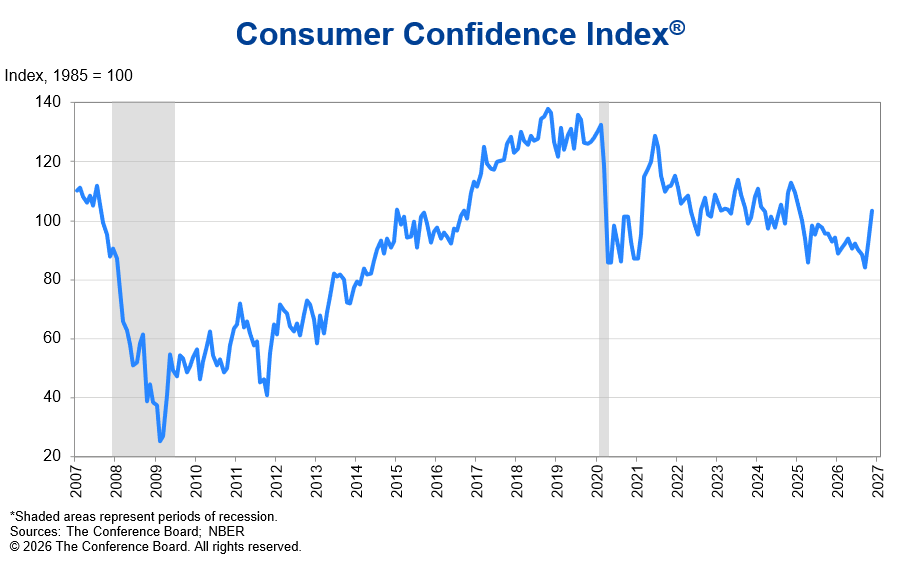
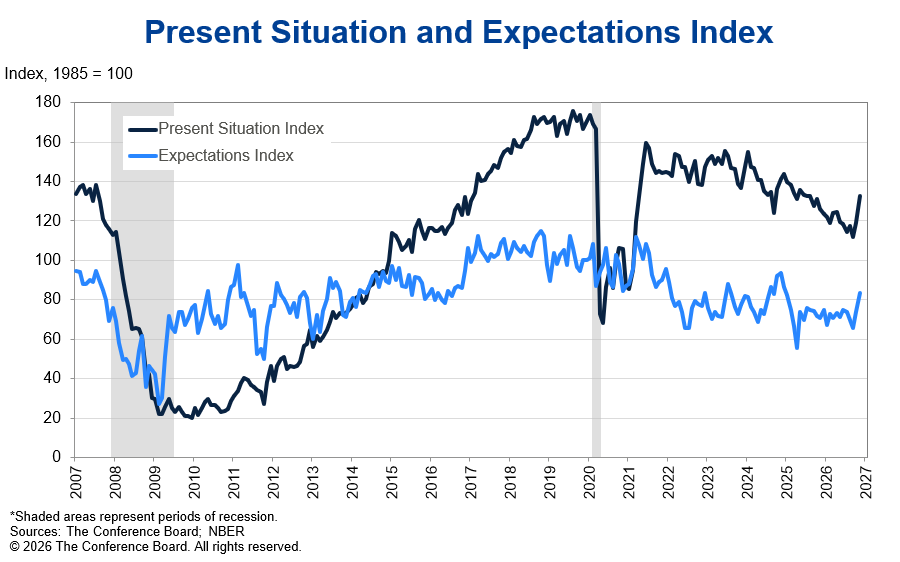
The Conference Board Consumer Confidence Index® rose by 11.4 points to 103.3 (1985=100) in November, up from 91.9 in October. The Present Situation Index—based on consumers’ assessment of current business and labor market conditions—increased by 13.7 points to 132.8. The Expectations Index—based on consumers’ short-term outlook for income, business, and labor market conditions—improved by 9.9 points to 83.6. The survey period for this month’s preliminary results was November 1-17.
“Consumer confidence rallied again in November, potentially due to lower uncertainty following the midterm elections,” said Fergus McCormick, Senior Economist, Global Indicators, The Conference Board. “After two months of consecutive increases, the headline index is back to levels of confidence last seen in January 2025. The gain in confidence was led by stronger perceptions of present and future labor market conditions. Perceptions of current and future business conditions also improved sharply. Along with the gain in headline confidence, consumers planned slightly higher spending on goods and vacations.”
McCormickcontinued: “Write-in responses in November were slightly less negative than previous months. While consumers continued to express frustration with high prices and rising costs, some comments cited hope for the general economy. Comments about war and conflict ticked up slightly, along with mixed feelings about elections, politics, and the direction of the labor market.”
The Present Situation Index jumped for a second consecutive month in November. Net views of current business conditions—the share saying conditions are “good” versus “bad”—increased by 3.5 percentage points to +6.5%. Perceptions of current employment conditions were notably more favorable, with the labor market differential—the share of consumers saying jobs are “plentiful” minus the share saying jobs are “hard to get”—improving by 7.6 ppts to +12.4%.
The Expectations Index also increased further in November, driven by higher expectations for future business conditions and the labor market. Expected household income likewise remained optimistic. Net expectations for business conditions climbed back into positive territory, rising by 5.1 ppts to +2.3%. Net expectations for the labor market were notably less pessimistic, increasing by 9.2 ppts to just –1.2%. Net expectations for household income eased by 0.7 ppts to +6.3%.
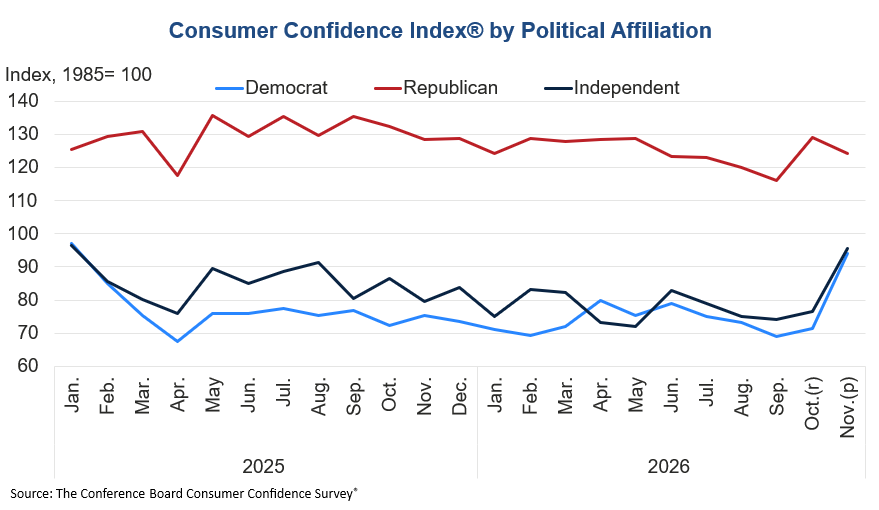
All age groups and generations recorded an increase in confidence in November, with the greatest increase by Gen Z respondents. Improvements in confidence were largest among consumers with higher household incomes. By political affiliation, confidence among Democrats and Independents improved sharply, while confidence among Republican respondents fell slightly. Regardless, confidence among Republicans remained the highest by political affiliation.
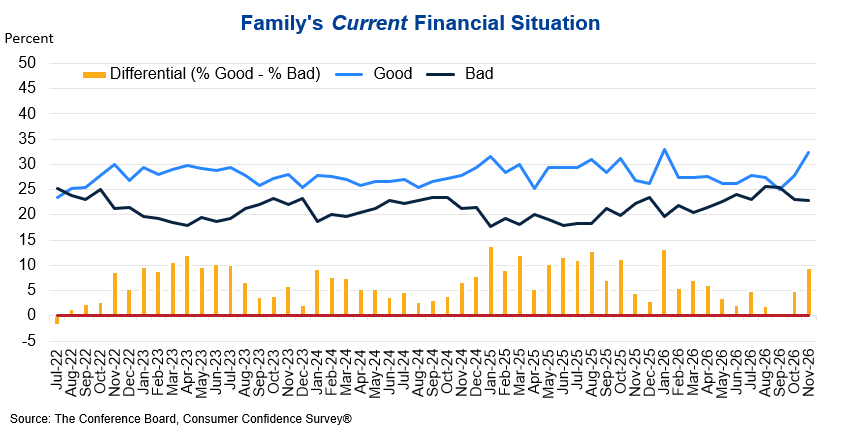
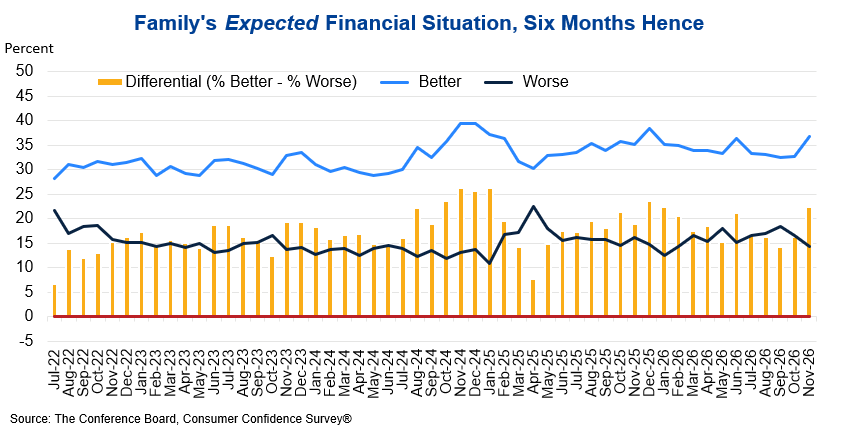
Consumers continued to feel better about their Family’s Current Financial Situation in November. Views of their Family’s Future Financial Situation over the next six months remained optimistic. Asked to assess the likelihood of a US recession over the next 12 months, the share of consumers citing “not likely” as an answer advanced. (These measures are not included in calculating the Consumer Confidence Index®).
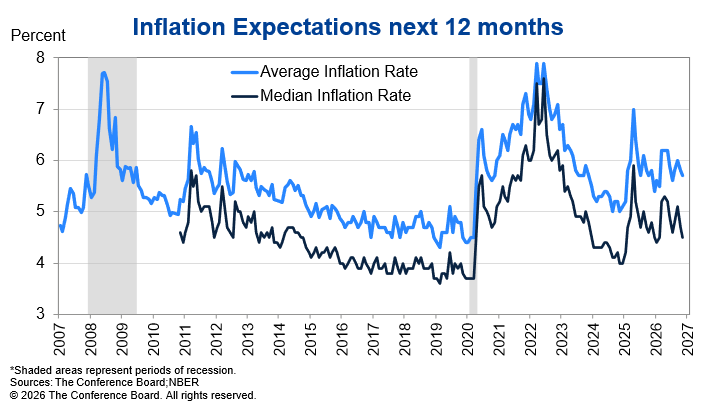
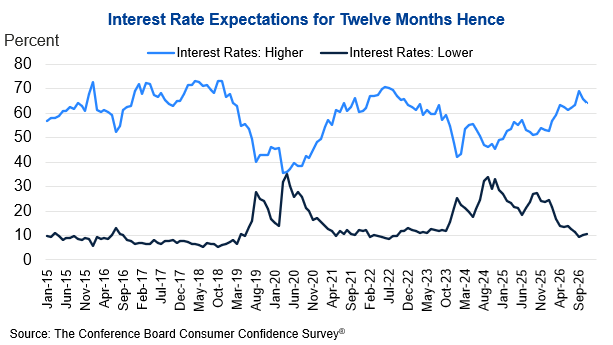
Consumers’ average 12-month inflation expectations declined for a second consecutive month in November, but remained elevated at 5.7%. Consumers still expected higher interest rates over the next 12 months. Market volatility in the first half of November notwithstanding, more consumers expected stock prices to increase rather than decrease in the next 12 months.
On a month-over-month as well as on a six-month moving average basis, plans to purchase autos and homes both improved slightly in November. Planned spending on durable goods in the month generally increased across the board.
Expected spending on services over the next six months was mixed. Anticipated spending on hotels and airfare for personal travel increased. Other increases in planned spending remained concentrated on discretionary items such as gambling and lottery, amusement parks and/or outdoor recreation, and historic sites, museums, and libraries. The top spending plans included restaurants, bars, take-out; streaming, internet, mobile services; utilities; health care; and beauty, personal care, but these categories were somewhat less prioritized compared to previous months.
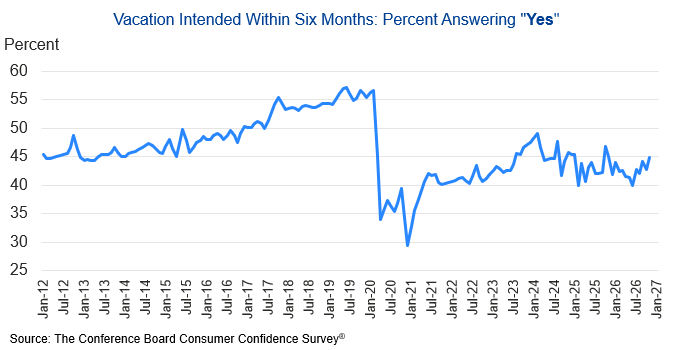
Vacation plans improved, with 44.9% of consumers considering a vacation in the next six months, up 2.2 ppts in November from 42.7% in October. More consumers planned domestic trips but fewer visits to foreign countries.
Present Situation
Consumers’ views of current business conditions improved in November:
- 23.3% of consumers said business conditions were “good,” up from 20.8% in October.
- 16.8% said business conditions were “bad,” down from 17.8%.
Consumers’ views of the labor market were more positive in November:
- 30.8% of consumers said jobs were “plentiful,” up from 26.2% in October.
- 18.4% of consumers said jobs were “hard to get,” down from 21.4%.
Expectations Six Months Hence
Consumers were hopeful about future business conditions in November:
- 19.6% of consumers expected business conditions to improve, up from 17.5% in October.
- 17.3% expected business conditions to worsen, down from 20.3%.
Consumers were significantly less negative about the labor market outlook in November:
- 18.1% of consumers expected more jobs to be available, up from 15.3% in October.
- 19.3% expected fewer jobs, down from 25.7%.
Consumers’ assessments of their income prospects eased slightly in November:
- 18.4% of consumers expected their income to increase, unchanged from last month.
- 12.1% expected their income to decline, up from 11.4%.
Dana M. Peterson, Allen Li, and Anna Larsen made significant contributions.
The monthly Consumer Confidence Survey®, based on an online sample, is conducted for The Conference Board by Toluna, a technology company that delivers real-time consumer insights and market research through its innovative technology, expertise, and panel of over 36 million consumers. The cutoff date for the preliminary results was November 17.
Source: November 2026 Consumer Confidence Survey®
The Conference Board
The Conference Board publishes the Consumer Confidence Index® at 10 a.m. ET on the last Tuesday of every month. Subscription information and the technical notes to this series are available on The Conference Board website: https://www.conference-board.org/data/consumerdata.cfm.
About The Conference Board
The Conference Board is the Member-driven think tank that delivers Trusted Insights for What's Ahead®®. Founded in 1916, we are a nonpartisan, not-for-profit organization holding 501 (c) (3) tax-exempt status in the United States. TCB.org l Learn about Membership
The next release is Tuesday, December 22nd at 10 AM ET.
© The Conference Board 2026. All data contained in this table are protected by United States and international copyright laws. The data displayed are provided for informational purposes only and may only be accessed, reviewed, and/or used in accordance with, and the permission of, The Conference Board consistent with a subscriber or license agreement and the Terms of Use displayed on our website at www.conference-board.org. The data and analysis contained herein may not be used, redistributed, published, or posted by any means without express written permission from The Conference Board.
COPYRIGHT TERMS OF USE All material on Our Sites are protected by United States and international copyright laws. You must abide by all copyright notices and restrictions contained in Our Sites. You may not reproduce, distribute (in any form including over any local area or other network or service), display, perform, create derivative works of, sell, license, extract for use in a database, or otherwise use any materials (including computer programs and other code) on Our Sites ("Site Material"), except that you may download Site Material in the form of one machine readable copy that you will use only for personal, noncommercial purposes, and only if you do not alter Site Material or remove any trademark, copyright or other notice displayed on the Site Material. If you are a subscriber to any of the services offered on Our Sites, you may be permitted to use Site Material, according to the terms of your subscription agreement.
Trademarks "THE CONFERENCE BOARD," the TORCH LOGO, "CONSUMER CONFIDENCE SURVEY", "CONSUMER CONFIDENCE INDEX", and other logos, indicia and trademarks featured on Our Sites are trademarks owned by The Conference Board, Inc. in the United States and other countries ("Our Trademarks").
You may not use Our Trademarks in connection with any product or service that does not belong to us nor in any manner that is likely to cause confusion among users about whether The Conference Board is the source, sponsor, or endorser of the product or service, nor in any manner that disparages or discredits us.