Email
Email
 Linkedin
 Facebook
 X
X
 Copy Link
The Conference Board publishes leading, coincident, and lagging indexes designed to signal peaks and troughs in the business cycle for major economies around the world.
The Conference Board Leading Economic Index® (LEI) for the US Edged Up in July
Latest Press Release
Updated: Thursday, August 20, 2026
Using the Composite Indexes: The Leading Economic Index (LEI) provides an early indication of significant turning points in the business cycle and where the economy is heading in the near term. The Coincident Economic Index (CEI) provides an indication of the current state of the economy. Additional details are below.
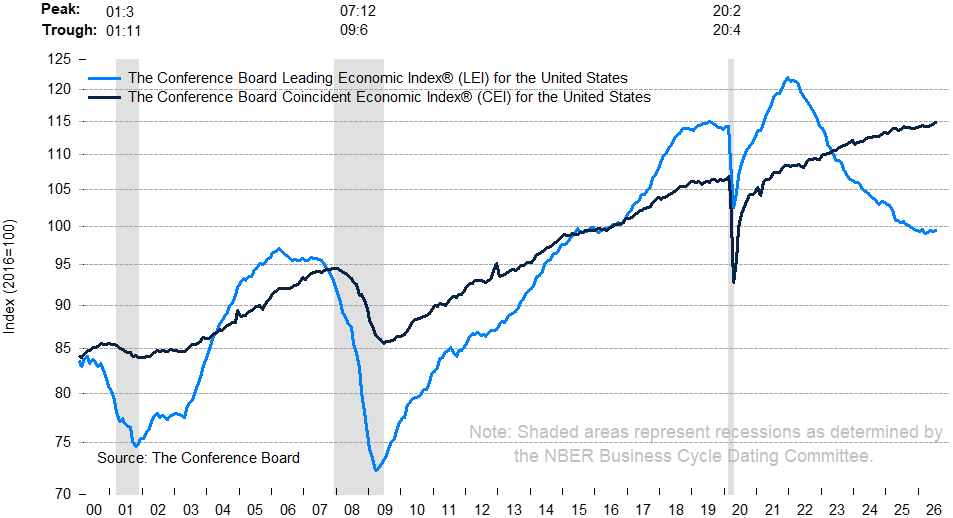
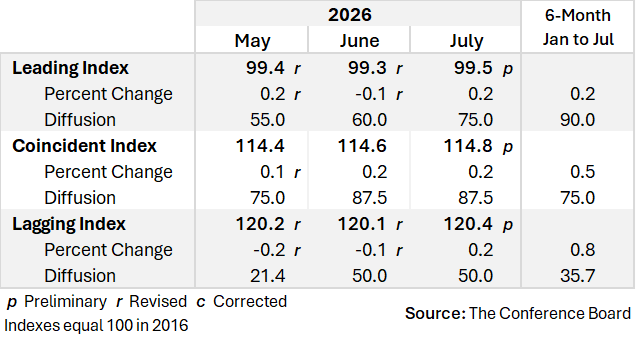
The Conference Board Leading Economic Index® (LEI) for the US increased by 0.2% in July 2026 to 99.5 (2016=100), after an upwardly revised decline of 0.1% in June. As a result, the LEI’s six-month growth rate turned positive, to an increase of 0.2% between January and July 2026, a sharp reversal from its 1.3% contraction over the previous six months.
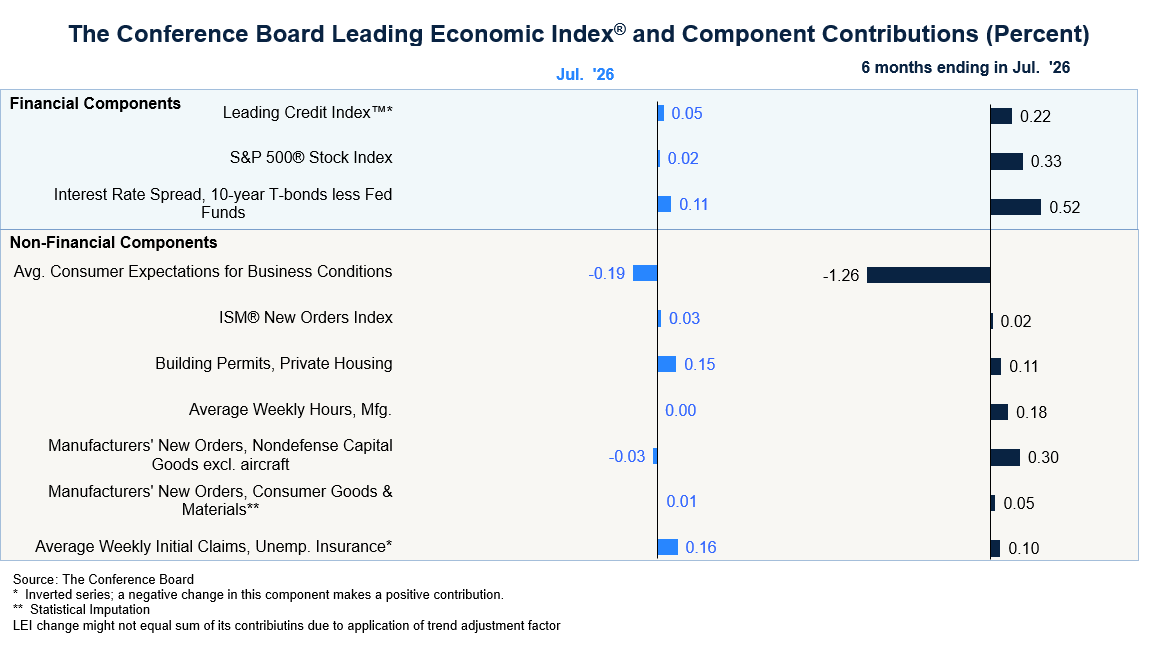
“The Leading Index for the US ticked up in July, marking the fourth increase over the past six months,” said Justyna Zabinska-La Monica, Senior Manager, Business Cycle Indicators, at The Conference Board. “Most components were positive in July except consumer expectations, which continued to be a notable drag on the overall index. With the most recent gains, the LEI’s six-month growth rate turned positive for the first time in more than four years, suggesting moderate growth ahead. The economy should keep expanding, but growth is expected to be driven by business investments in AI, while the higher cost of living may reduce consumer spending, especially by lower- and middle-income households. Consequently, The Conference Board continues to forecast real GDP growth of 1.9% in 2026 and 1.9% in 2027.”
The Conference Board Coincident Economic Index® (CEI) for the US increased by 0.2% in July 2026 to 114.8 (2016=100), following a 0.2% increase in June. Overall, the CEI expanded by 0.5% over the six months between January and July 2026, after remaining flat over the previous six months. The CEI’s four component indicators—payroll employment, personal income less transfer payments, manufacturing and trade sales, and industrial production—are included among the data used to determine recessions in the US. All components of the CEI, except for payroll employment, made positive contributions last month.
The Conference Board Lagging Economic Index® (LAG) for the US increased by 0.2% in July 2026 to 120.4 (2016=100). Despite the month-over-month increase, the level of the index was still below the preliminary June level of 120.5 (2016=100), due to downward revisions from April to June 2026. The LAG was up 0.8% between January and July 2026, doubling its 0.4% growth over the prior six months (July 2025 to January 2026).
The US LEI edged up in July marking the fourth increase over the past six months
Consumer expectations remained weak, but the drag was more than offset by positive contribiutons from jobless claims and building permits
The LEI’s six-month growth rate turned postive for the first time in over four years
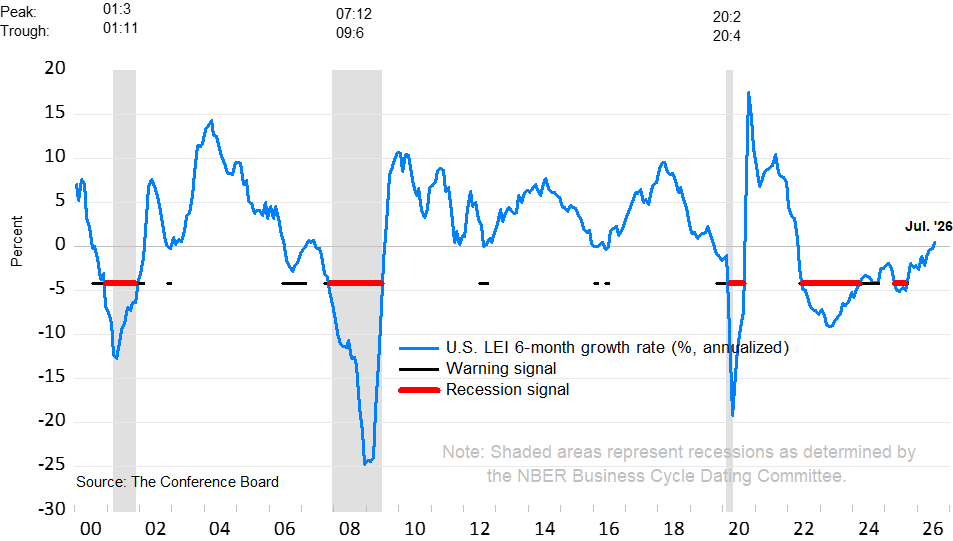
NOTE: The chart illustrates the so-called 3Ds—duration, depth, and diffusion—for interpreting a downward movement in the LEI. Duration refers to how long the decline has lasted. Depth denotes the size of decline. Duration and depth are measured by the rate of change of the index over the most recent six months at an annualized rate. Diffusion is a measure of how widespread the decline is among the LEI’s component indicators—on a scale of 0 to 100, a diffusion index reading below 50 indicates most components are weakening.
The 3Ds rule signals an impending recession when: 1) the six-month diffusion index lies at or below 50, shown by the black warning signal lines in the chart; and 2) the LEI’s six-month growth rate (annualized) falls below the threshold of −4.3%. The red recession signal lines indicate months when both criteria are met simultaneously—and thus that a recession is likely imminent or underway.
Summary Table of Composite Economic Indexes
About The Conference Board Leading Economic Index® (LEI) and Coincident Economic Index® (CEI) for the US
The composite economic indexes are key elements in an analytic system designed to signal peaks and troughs in the business cycle. Comprised of multiple independent indicators, the indexes are constructed to summarize and reveal common turning points in the economy in a clearer and more convincing manner than any individual component.
The CEI reflects current economic conditions and is highly correlated with real GDP. The LEI is a predictive tool that anticipates—or “leads”—turning points in the business cycle by around seven months.
The ten components of the Leading Economic Index® for the US are:
- Average weekly hours in manufacturing
- Average weekly initial claims for unemployment insurance
- Manufacturers’ new orders for consumer goods and materials
- ISM® Index of New Orders
- Manufacturers’ new orders for nondefense capital goods excluding aircraft orders
- Building permits for new private housing units
- S&P 500® Index of Stock Prices
- Leading Credit Index™
- Interest rate spread (10-year Treasury bonds less federal funds rate)
- Average consumer expectations for business conditions
The four components of the Coincident Economic Index® for the US are:
- Payroll employment
- Personal income less transfer payments
- Manufacturing and trade sales
- Industrial production
To access data, please visit: https://www.conference-board.org/data
About The Conference Board
The Conference Board is the Member-driven think tank that delivers Trusted Insights for What's Ahead®®. Founded in 1916, we are a nonpartisan, not-for-profit organization holding 501 (c) (3) tax-exempt status in the United States. TCB.org l Learn about Membership