A Stable Democracy at 250: Trusted Elections as the Foundation
Our Privacy Policy has been updated! The Conference Board uses cookies to improve our website, enhance your experience, and deliver relevant messages and offers about our products. Detailed information on the use of cookies on this site is provided in our cookie policy. For more information on how The Conference Board collects and uses personal data, please visit our privacy policy. By continuing to use this Site or by clicking "ACCEPT", you acknowledge our privacy policy and consent to the use of cookies. 
Our Privacy Policy has been updated! Detailed information on the use of cookies on this site is provided in our cookie policy and our privacy policy. 
TCB Tourch
Loading...
  •  
    • NORTH AMERICA
    • EUROPE
    • ASIA
  • 2

    Close
    • Insights
        • Insights
        • Explore by Center
          • Explore by Center
          • CED
            Committee for Economic Development

          • Economy, Strategy & Finance

          • Governance & Sustainability

          • Human Capital

          • Marketing & Communications

        • Explore by Content Type
          • Explore by Content Type
          • Reports

          • Upcoming Webcasts

          • On Demand Webcasts

          • Podcasts

          • Charts & Infographics

          • Explore All Research

          • Economic Indicators

        • Trending Topics
          • Trending Topics
          • Artificial Intelligence (AI)

          • Navigating Washington

          • Geopolitics

          • US Economic Forecast

          • Sustainability

          • Future of Work

          • Explore All Trending Topics

    • Events
        • Events
        • Upcoming Events
          • Upcoming Events
          • CLO Governance Forum

          • Reimagine Asia 2026: People & Business

          • Executive Compensation & Talent: Navigating New Expectations, New Metrics, New Models

          • The Annual Employee Health Care Conference – Chicago

          • People First: Elevating Talent for the Future

          • 2026 M&A Summit - San Francisco

          • Explore All Upcoming Events

          • Speaker Bureau

          • Sponsor a Program

        • Member-Exclusive Programs
          • Member-Exclusive Programs
          • Center Briefings

          • Expert Briefings

          • Experts Live

          • Roundtables

          • Working Groups

          • View All Member-Exclusive Programs

          • View All Upcoming Events, Programs, and Webcasts

    • Data
        • Data
        • All Data

        • Consumer Confidence Index®

        • Data Central

        • TCB Benchmarking

        • Recession & Growth Trackers

        • Global Economic Outlook

        • Leading Economic Indicators

        • Help Wanted OnLine

        • Labor Markets

        • Measure of CEO Confidence

        • CMO+CCO Meter Dashboard

    • Centers
        • Centers
        • Our Centers
          • Our Centers
          • Committee for Economic Development

          • Economy, Strategy & Finance

          • Governance & Sustainability

          • Human Capital

          • Marketing & Communications

    • Councils
        • Councils
        • Find a Council
          • Find a Council
          • Economy, Strategy & Finance

          • Governance & Sustainability

          • Human Capital

          • Marketing & Communications

          • Explore All Councils

        • Council Membership
          • Council Membership
          • What is a Council?

          • Benefits of Council Membership

          • Apply to a Council

    • Membership
        • Membership
        • Types of Membership
          • Types of Membership
          • Membership at a Glance

          • Executive

          • C-Suite

          • Leadership Team

          • Council

          • Higher Education

          • Insights

        • Already a Member?
          • Already a Member?
          • Check if Your Organization is a Member

          • Sign In to myTCB®

          • Executive Communities

          • Member-Exclusive Programs

          • Refer a Leader - Earn a Reward

    • About Us
        • About Us
        • Who We Are
          • Who We Are
          • About Us

          • In the News

          • Press Releases

          • Our History

          • Support Our Work

          • Locations

          • Contact Us

        • Our Community
          • Our Community
          • Our Leadership

          • Our Experts

          • TCB Speaker Bureau

          • Trustees

          • Voting Members

          • Global Counsellors

          • Careers

          • This Week @ TCB

          • Continuing Education Credits (CEUs)

    • Careers
    • This Week @ TCB
    • Sign In to myTCB®
      • NORTH AMERICA
      • EUROPE
      • ASIA
    • Insights
      • Insights
      • Explore by Center
        • Explore by Center
        • CED
          Committee for Economic Development

        • Economy, Strategy & Finance

        • Governance & Sustainability

        • Human Capital

        • Marketing & Communications

      • Explore by Content Type
        • Explore by Content Type
        • Reports

        • Upcoming Webcasts

        • On Demand Webcasts

        • Podcasts

        • Charts & Infographics

        • Explore All Research

        • Economic Indicators

      • Trending Topics
        • Trending Topics
        • Artificial Intelligence (AI)

        • Navigating Washington

        • Geopolitics

        • US Economic Forecast

        • Sustainability

        • Future of Work

        • Explore All Trending Topics

    • Events
      • Events
      • Upcoming Events
        • Upcoming Events
        • CLO Governance Forum

        • Reimagine Asia 2026: People & Business

        • Executive Compensation & Talent: Navigating New Expectations, New Metrics, New Models

        • The Annual Employee Health Care Conference – Chicago

        • People First: Elevating Talent for the Future

        • 2026 M&A Summit - San Francisco

        • Explore All Upcoming Events

        • TCB Speaker Bureau

        • Sponsor a Program

      • Member-Exclusive Programs
        • Member-Exclusive Programs
        • Center Briefings

        • Expert Briefings

        • Experts Live

        • Roundtables

        • Working Groups

        • View All Member-Exclusive Programs

        • View All Upcoming Events, Programs, and Webcasts

    • Data
      • Data
      • All Data

      • Consumer Confidence Index®

      • Data Central

      • TCB Benchmarking

      • Recession & Growth Trackers

      • Global Economic Outlook

      • Leading Economic Indicators

      • Help Wanted OnLine

      • Labor Markets

      • Measure of CEO Confidence

      • CMO+CCO Meter Dashboard

    • Centers
      • Centers
      • Our Centers
        • Our Centers
        • Committee for Economic Development

        • Economy, Strategy & Finance

        • Governance & Sustainability

        • Human Capital

        • Marketing & Communications

    • Councils
      • Councils
      • Find a Council
        • Find a Council
        • Economy, Strategy & Finance

        • Governance & Sustainability

        • Human Capital

        • Marketing & Communications

        • Explore All Councils

      • Council Membership
        • Council Membership
        • Benefits of Council Membership

        • Apply to a Council

        • Our Program Directors

        • Refer a Leader - Earn a Reward

    • Membership
      • Membership
      • Types of Membership
        • Types of Membership
        • Membership at a Glance

        • Executive

        • C-Suite

        • Leadership Team

        • Council

        • Higher Education

        • Insights

      • Already a Member?
        • Already a Member?
        • Check if Your Organization is a Member

        • Sign In to myTCB®

        • Executive Communities

        • Member-Exclusive Programs

        • Refer a Leader - Earn a Reward

    • About Us
      • About Us
      • Who We Are
        • Who We Are
        • About Us

        • In the News

        • Press Releases

        • This Week @ TCB

        • Our History

        • Support Our Work

        • Locations

        • Contact Us

      • Our Community
        • Our Community
        • Our Leadership

        • Our Experts

        • TCB Speaker Bureau

        • Trustees

        • Voting Members

        • Global Counsellors

        • Careers

        • This Week @ TCB

        • Continuing Education Credits (CEUs)

    • Careers
    • Sign In to myTCB®
    • Download TCB Insights App
  • Insights
    Insights

    Our research and analysis have helped the world's leading companies navigate challenges and seize opportunities for over 100 years.

    Economic Indicators

    • Explore by Center
    • CED
      Committee for Economic Development
    • Economy, Strategy & Finance
    • Governance & Sustainability
    • Human Capital
    • Marketing & Communications
    • Explore by Content Type
    • Reports
    • Upcoming Webcasts
    • On Demand Webcasts
    • Podcasts
    • Charts & Infographics
    • Trending Topics
    • Artificial Intelligence (AI)
    • Navigating Washington
    • Geopolitics
    • US Economic Forecast
    • Sustainability
    • Future of Work
    • Explore All Trending Topics
  • Events
    Events

    Our in-person and virtual events offer unmatched opportunities for professional development, featuring top experts and practitioners.

    View All Upcoming Events, Programs, and Webcasts

    TCB Speaker Bureau

    Sponsor a Program

    • Upcoming Events
    • CLO Governance Forum

      September 10, 2026

      Reimagine Asia 2026: People & Business

      September 10, 2026

      Executive Compensation & Talent: Navigating New Expectations, New Metrics, New Models

      September 24 - 25, 2026

    •  
    • The Annual Employee Health Care Conference – Chicago

      September 24 - 25, 2026

      People First: Elevating Talent for the Future

      October 06 - 07, 2026

      2026 M&A Summit - San Francisco

      October 14, 2026

    • Member-Exclusive Programs
    • Center Briefings
    • Expert Briefings
    • Experts Live
    • Roundtables
    • Working Groups
    • View All Member-Exclusive Programs
    • Explore by Type
    • Events
    • Webcasts
    • Podcasts
    • Member-Exclusive Programs
    • Center Briefings
    • Expert Briefings
    • Experts Live
    • Roundtables
    • Working Groups
    • View All Member-Exclusive Programs
  • Data
    Corporate Disclosure Data

    TCB Benchmarking

    Real-time data visualizations to benchmark your governance, compensation, environmental, human capital management (HCM) and social practices against US public companies.

    Economic Data

    All Data

    Consumer Confidence Index®

    Data Central

    One-stop, member-exclusive portal for the entire suite of indicators

    Labor Markets

    Measure of CEO Confidence


    Recession & Growth Trackers

    Current & future state of 16 economies

    Global Economic Outlook

    Growth outlooks for 77 economies

    Leading Economic Indicators

    State of the business cycle for 12 global economies across Asia and Europe

    Help Wanted OnLine

    Status of the US job market

    Other Featured Data

    CMO+CCO Meter Dashboard

  • Centers
    Centers

    Centers offer access to world-class experts, research, events, and senior executive communities.

    Our Centers
    • Committee for Economic Development
    • Economy, Strategy & Finance
    • Governance & Sustainability
    • Human Capital
    • Marketing & Communications
  • Councils
    Councils

    Councils are invitation-only, peer-led communities of senior executives that come together to exchange knowledge, accelerate career development, and advance their function.

    Find a Council
    • Economy, Strategy & Finance
    • Governance & Sustainability
    • Human Capital
    • Marketing & Communications
    • Explore All Councils
    Council Membership
    • Benefits of Council Membership
    • Apply to a Council
    • Our Program Directors
    • Refer a Leader - Earn a Reward
  • Membership
    Membership

    Membership in The Conference Board arms top executives and their teams with an arsenal of knowledge, networks, and expertise that's unmatched in scope and depth.

    • Types of Membership
    • Membership at a Glance
    • Executive
    • C-Suite
    • Leadership Team
    • Council
    • Higher Education
    • Insights
    • Already a Member?
    • Check if Your Organization is a Member
    • Sign in to myTCB®
    • Executive Communities
    • Member-Exclusive Programs
    • Refer a Leader - Earn a Reward
  • About Us
    About Us

    The Conference Board is the global, nonprofit think tank and business membership organization that delivers Trusted Insights for What's Ahead®. For over 100 years, our cutting-edge research, data, events and executive networks have helped the world's leading companies understand the present and shape the future.

    • Who We Are
    • About Us
    • In the News
    • Press Releases
    • Our History
    • Support Our Work
    • Locations
    • Contact Us
    • Our Community
    • Our Leadership
    • Our Experts
    • TCB Speaker Bureau
    • Trustees
    • Voting Members
    • Careers
    • This Week @ TCB
    • Continuing Education Credits (CEUs)
Check if You're a Member
Create Account
Forgot Your Password?

Members of The Conference Board get exclusive access to the full range of products and services that deliver Trusted Insights for What's Ahead ® including webcasts, publications, data and analysis, plus discounts to conferences and events.

Solutions Briefs

A Stable Democracy at 250: Trusted Elections as the Foundation

19 May 2026 / Report

Download Report  
  • Report
  • Infographic
  • Elections Toolkit
  • Email
  • Linkedin
  • Facebook
  • X
  • Copy Link

Free and fair elections are a cornerstone of US democracy, supporting both political stability and economic strength. A secure, credible, and accessible electoral system fosters business confidence, enabling companies to operate with trust in governance and engage in shaping policy.

Trusted Insights for What’s Ahead®

  • The US has an exceptional history of election integrity, including open and fair elections. Trusted elections are the foundation of a strong democracy and economic growth. Continued confidence in the security and integrity of US elections is critical to the stability and strength of democracy and to economic strength. For businesses that rely on public trust, engaging on the importance of election integrity is a risk optimization decision, not a political one.
  • Voting patterns continue to evolve. Ensuring voting methods are secure, reliable, and transparent—while clearly communicating how they work and the safeguards in place—is essential to sustaining participation and public trust.
  • Vigilance in ensuring the secure and effective administration of elections is fundamental to safeguarding election integrity, particularly as aging voting infrastructure and increasingly sophisticated cybersecurity threats expose critical vulnerabilities. Sustained investment in modern, resilient systems—along with stronger protections for election officials—is essential to strengthening security and maintaining a capable, trusted election workforce, including volunteer poll workers.
  • The Constitution assigns primary responsibility for election administration to the states, reflecting the nation’s federal structure, while nonpartisan and bipartisan governance at the state and local levels remains essential to sustaining public trust. Still, the Federal government has an important role—particularly in cybersecurity and threat intelligence—in identifying and responding to risks, including those posed by domestic and foreign actors.
  • Sharing trusted information is essential to building confidence in elections. Business leaders, as trusted members of their communities, play a critical role to disseminate accurate information from official government sources on voting processes and security measures, while also supporting broad civic participation and a strong citizenry. The Committee for Economic Development (CED), the public policy Center of The Conference Board®, is offering a toolkit to assist in this process.

Recommendations

The role of the business community

  • Business leaders should proactively use their platforms to encourage voting, recognizing its central role in maintaining a stable civil society and a prosperous economy.
  • Business leaders should leverage their position as leaders of a highly trusted institution to engage employees, customers, owners, and local communities in a balanced, nonpartisan manner.
  • The business community has the opportunity to enable civic participation and provide accommodations for eligible employees to participate in the democratic process.

The administration of elections

  • Pre-election audits and transparent processes, conducted on a nonpartisan or bipartisan basis, help identify and resolve issues well before Election Day and strengthen voters’ confidence in the elections process.
  • All voting machines should produce a paper record to give voters confidence that the vote they cast is the vote recorded and to assist with recounts. States should require post-election audits to ensure accurate counting and be transparent to safeguard against false election claims.
  • Ongoing attention to the security of voter registration systems, voting equipment, and broader election infrastructure underpin public trust. Election administrators should rigorously test voting equipment for potential vulnerabilities and proactively communicate the security measures they implement to strengthen confidence and promote best practices for adoption across states.
  • States should be held accountable in the maintenance of voter registration lists and conduct annual updates of those lists.

The conduct of elections

  • Everyone who is legally eligible to vote should have the opportunity to do so safely, securely, and conveniently.
  • A range of voting options—including in-person voting, early voting, and voting by mail (VBM)—should be available to accommodate diverse needs, provided that strong standards for security and integrity are maintained consistently.
  • Election administrators must remain vigilant against intimidation, harassment, and interference.
  • States should expand protections for election administrators and increase penalties for those interfering with their duties.
  • Vote counting should be conducted in a timely, transparent, and accurate manner using reliable procedures and safeguards, reinforcing confidence in the integrity and finality of election results.

Federal, state, and local roles

  • While the Constitution assigns primary responsibility for the administration of elections to the states, the Federal government plays a critical supporting role, particularly in providing cybersecurity resources, intelligence, and coordination to help identify and respond to potential or active threats that span state or national boundaries.
  • State and local election administration should be conducted on a nonpartisan or bipartisan basis to strengthen public trust and ensure that elections are managed fairly and impartially.
  • States should continuously update and strengthen election systems, equipment, and coordination practices to address emerging risks and maintain public confidence in election security.

Information integrity risks

  • The modern information environment presents rapidly evolving challenges—including deepfakes, misinformation, disinformation (false information distributed with deceptive intent), echo chambers, algorithmic amplification, and manipulated content—that can erode public trust in elections. Policymakers, in collaboration with business leaders, should develop measures to identify, deter, and educate the public about deepfakes and other forms of disinformation and information integrity risks.
  • A coordinated approach is necessary to counter disinformation, with candidates and institutions playing a central role in upholding standards of integrity and reinforcing trust in the information environment.
  • Addressing emerging risks that could undermine election systems will require deliberate approaches, including greater transparency and appropriate safeguards, which may present a role for regulation at the Federal or state level.

Voters

  • Public education efforts should clearly communicate how, when, and where to vote, ensuring that information is accurate and linked to official sources. Providing reliable and transparent information about election processes and security is crucial to countering disinformation and misinformation about and during the elections process.
  • Open dialogue and robust debate among candidates should be encouraged, as this plays a critical role in strengthening democratic participation, increasing public awareness of key issues, and promoting accountability. Fostering a climate where candidates engage constructively can help voters make more informed decisions and reinforce trust in the democratic process.

Business leaders

  • Business leaders should share trusted information on local voting processes—including registration deadlines and options for early and mail-in voting—to ensure their employees are informed and empowered to participate.
  • Business leaders can encourage their employees to serve as poll workers, particularly in communities facing shortages.
  • Business leaders should collaborate with government to expand efforts to understand how the public interprets AI-generated media.
  • Business leaders, working with Congress, should take the steps necessary to enable voters to identify misinformation and disinformation. Best practices in identifying synthetic media should be made public and spread widely

Elections and the Role of the Business Community

Given the central role that a strong democracy plays in sustaining a prosperous economy, business leaders have a strong interest in supporting voting and civic participation. At a time when trust in both democratic institutions and capitalism has declined, it is critical to recognize that the two are intrinsically connected. According to a 2025 Gallup poll, 54% of US adults view capitalism favorably—the lowest level recorded since Gallup began tracking these attitudes in 2010.1 Trust in government is also falling. According to a 2025 Pew Research Center study, only 17% of Americans say they trust the Federal government to do what is right “just about always” or “most of the time.” The current measure is one of the lowest in the nearly seven decades since the question was first asked by the National Election Survey.2 A stable democracy produces more predictable governance—essential for capital formation, economic confidence, long-term prosperity, and avoiding detrimental distortions such as crony capitalism.

As leaders of one of society’s most trusted institutions, business leaders are uniquely positioned to engage employees, customers, shareholders, and local communities in a balanced, nonpartisan manner. According to the 2026 Edelman Trust Barometer, 64% of respondents trust businesses to act responsibly, versus 53% for government.3 Trust is even higher at the organizational level, with 78% of individuals expressing confidence in their own employer, making it the most trusted institution. By reinforcing the value of civic participation and supporting confidence in democratic processes, business leaders can help rebuild trust in both governance and the economic system it supports.

The business community is also well positioned to facilitate broad civic participation. This includes providing practical support such as flexible scheduling or time off to ensure employees not only can vote but also serve as volunteer poll workers if they wish. By enabling engagement in the democratic process, businesses can help foster a more informed and active citizenry, which, in turn, supports a stable and thriving business environment.

While we already have a strong election system, it is essential to ensure this system continues to work well today and into the future. Today, each participant in the system –state and local governments, candidates, voters, the business community, and the Federal government—plays an essential role in ensuring the integrity, security, and fairness of our elections.

The Administration of Elections

Practices to strengthen public trust in election integrity

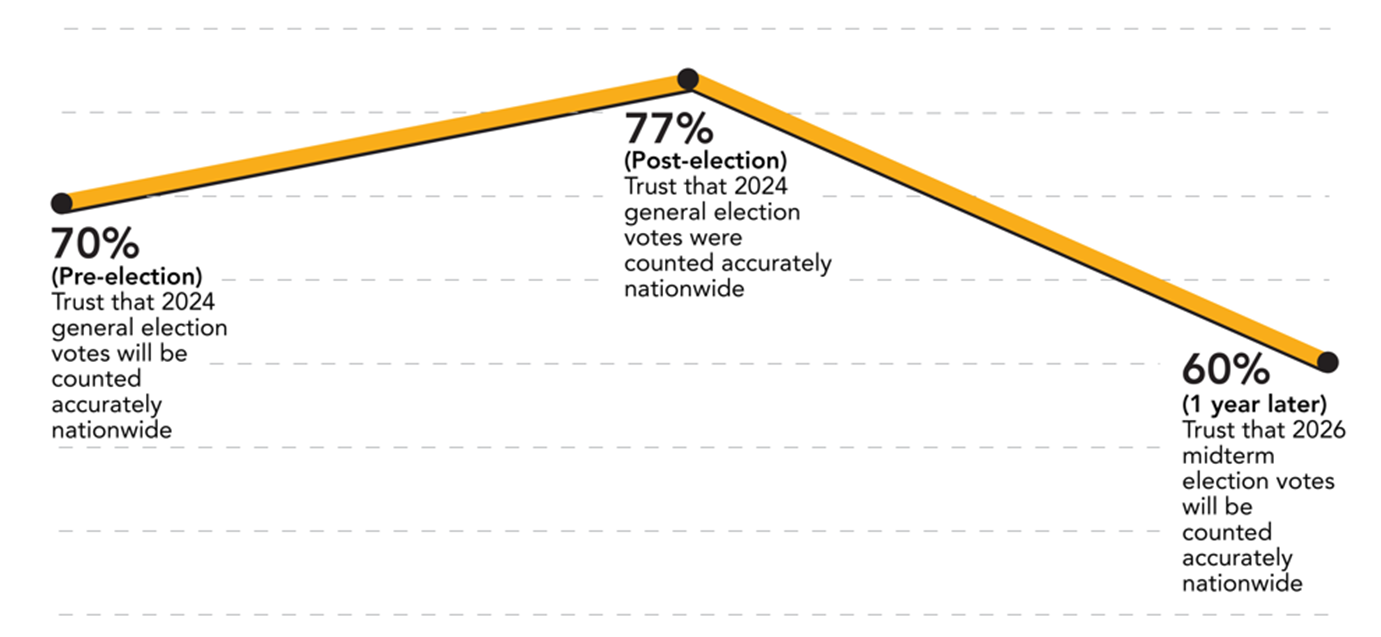
Notwithstanding statistics that confirm the integrity of US elections, confidence in the integrity of elections among US voters has fallen sharply since the 2024 Presidential election.4 In a survey of over 11,400 eligible voters conducted December 2025 through January 2026, 60% said they are confident votes will be counted accurately nationwide in the 2026 midterm elections. This marks a notable decline from confidence levels surrounding the 2024 Presidential election, which rose from 71% before the election to 77% immediately afterward.

Figure 1

Shifts in trust in elections in 2024 and 2025


Source: University of California San Diego and The Conference Board, 2026

Public trust in elections is strengthened by voting practices that are transparent and verifiable. Paper records of ballots cast are central to this approach, giving voters confidence that the vote they cast is the vote recorded. They also allow for the conducting of post-election audits, in which election workers check paper records against electronic totals to confirm that voting machines are working as intended. These measures and methods should be conducted transparently to build public confidence in the counting of votes, in turn building resistance to election falsehoods.

After the Help America Vote Act (HAVA) of 2002 was enacted, many jurisdictions deployed direct-recording electronic (DRE) machines, most of which did not include voter-verified paper audit trail (VVPAT) printers, prompting controversy over whether these systems could be trusted to count votes accurately.5 Because of concerns raised by some computer scientists, DRE use has declined in recent years. Additionally, some DREs now include a VVPAT to allow for checking the electronically recorded vote against the paper record. VVPAT is a crucial safeguard to build public confidence in election results.

Estimates suggest that in November 2026,6 only 1.3% of registered voters will live in jurisdictions using DREs without VVPAT, down from 22% in 2016.7 In Louisiana, 100% of registered voters live in jurisdictions where ballots are cast using DREs without VVPAT. Texas is the only other state that continues to use DREs without VVPAT, though only one jurisdiction is expected to use this equipment, accounting for just 0.1% of the state’s registered voters.

Audits serve as a critical safeguard against errors, vulnerabilities, or potential interference throughout the entirety of the elections process, while also providing transparency to the complexities of election administration. Pre-election audits play a preventative role in election administration by verifying that voting machines are functioning correctly before voting begins. Every state and territory conducts “logic and accuracy” testing, a process that involves the testing of voting equipment by casting a predetermined set of test ballots and confirming that the results match the expected outcomes.8 If a tabulator malfunctions during the test or produces inaccurate results, it is subject to reprogramming or maintenance, or is removed entirely.

The practice of election auditing extends beyond the post-election tabulation audit. Another essential component of the pre-election process—as well as during the election and the post-election period—is ballot management audits.9 An audit of ballot management records ensures that election officials had properly handled ballots throughout the entire election process through secure custody, accurate accounting, and documented chain-of-custody procedures, strengthening overall election integrity and confidence in the results.

Given the increased prevalence of VBM, mail ballot validation audits have become increasingly important. The most common method for validating that a mail or absentee ballot was completed by the intended voter is signature verification.10 When a mailed ballot is returned, election officials compare the signature on the voter’s returned ballot envelope to a reference signature, typically one from the voter registration record.

States must continue to maintain accurate voter registration lists

While illegal voting is exceedingly rare,11 the maintenance of voter rolls helps build confidence in election outcomes. In addition to ensuring that only eligible voters can cast a ballot, accurate voter registration lists inform Election Day planning by helping election administrators budget resources accordingly, including the location of polling places, voting machines, and poll workers. The National Voter Registration Act of 1993 (NVRA) and HAVA provide a regulatory floor for state actions on list maintenance.12 The NVRA requires states to conduct list maintenance in a uniform and nondiscriminatory manner in compliance with the Voting Rights Act, prohibits list maintenance activities within 90 days of an election, and limits the reasons a state may remove a voter from its rolls. HAVA requires states to develop a computerized, statewide voter registration list and coordinate records with state departments of vital statistics, corrections, and other state agencies.

Founded in 2012 by seven states, the Electronic Registration Information Center (ERIC)13 is a nonprofit, nonpartisan organization dedicated to improving the accuracy of voter rolls and increasing administrative efficiency. Now funded and governed by its 25 member states and the District of Columbia, ERIC operates by having members securely submit voter registration, motor vehicle, and identification data. Its technical staff then uses data-matching software to compare information across states and generate reports that help maintain accurate voter rolls, which member states use in compliance with Federal data protection laws.

No matter a state’s membership status with ERIC, all states must be held accountable for maintaining accurate voter registration lists and conduct annual updates of those lists to ensure confidence in elections.

The Conduct of Elections

All eligible and registered voters must be able to cast their ballots safely, securely, and conveniently, and should be encouraged—not deterred—from participating in the democratic process. This requires ensuring that voting occurs free from intimidation or harassment, that election workers can perform their duties without fear of violence or intimidation, and that polling sites are sufficiently staffed to operate efficiently and securely.

Since 2020, CED has recommended that states provide at least 10 days of early voting and expand VBM options to ensure elections could be conducted safely during the height of the pandemic.14 These expanded voting options—alternatives to in-person voting on Election Day—have had a lasting impact on how Americans cast their ballots, reinforcing and accelerating trends that began prior to the pandemic.

In the 2020 Presidential election, for the first time the majority of voters did not cast their ballots in person on Election Day: 30.5% in 2020 voted in person on election day, compared to 54.5% in 2016.15 The percentage of voters who voted by mail in 2020 rose to 43.1%, up from 24.5% in 2016. Similarly, the percentage of voters who used early in-person voting in 2020 stood at 30.6%, up from 25.3% in 2016.

The 2024 Presidential election made clear that changes in how Americans vote are here to stay. While VBM declined slightly to 30.3% in 2024, down from 31.9% in 2022, early in-person voting emerged as an increasingly popular method of casting a ballot at 35.2%, up from 22.2% in 2022.

Early voting

Early in-person voting allows voters expanded opportunities to vote ahead of Election Day. The option to vote during evening hours or on weekends provides greater access to those who otherwise may not have an opportunity to reach the polls. Forty-seven states and the District of Columbia currently offer early in-person voting to all voters.16 Only Alabama, Mississippi, and New Hampshire do not offer early in-person voting to all voters. In 2025, Alabama’s Governor vetoed seven pieces of legislation that, among other provisions, would have shortened mail ballot receipt deadlines and eliminated early in-person voting.17

VBM and absentee voting

VBM, also referred to as absentee voting, has been in use since the process helped soldiers cast ballots during the Civil War. Today, VBM is widely used and has become an essential part of how millions of Americans exercise their right to vote, including its use as the principal and default method of voting in a number of states, mostly in the West.

States that use VBM take an abundance of measures to ensure that this method of voting is secure, accurate, and confidential.18 Ballots are verified multiple times: first, election officials verify the voter’s name and information against their registration; then, election officials remove the sealed ballot from the outer envelope containing the voter’s identifiable information to ensure the vote remains confidential.

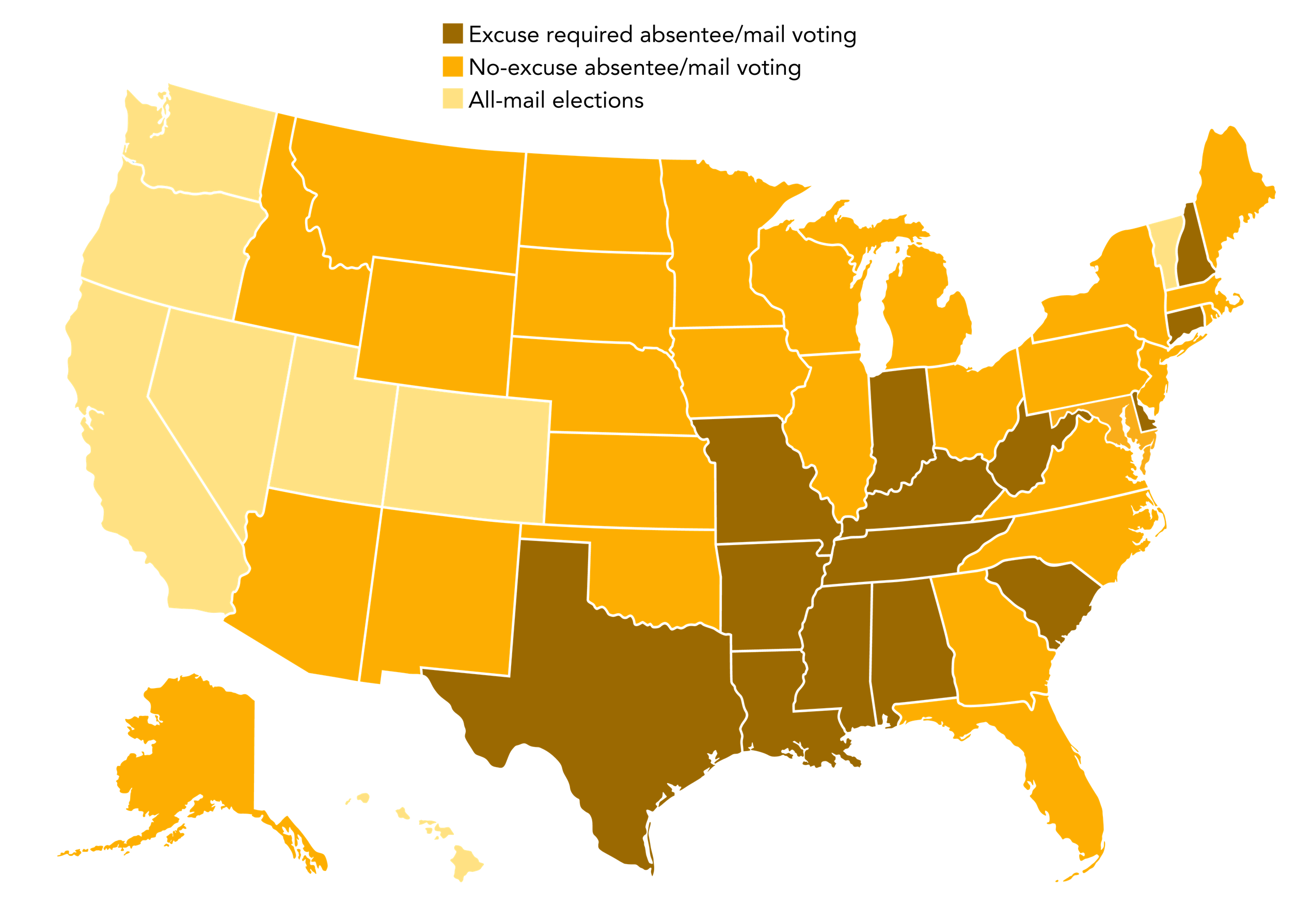
Figure 2

No-excuse mail/absentee voting

Source: National Conference of State Legislatures and The Conference Board, 2026

Currently, 28 states offer “no-excuse” absentee voting, meaning that any voter can request and cast a vote by mail with no excuse necessary.19 Eight states and the District of Columbia allow all elections to be conducted entirely by mail; while all registered voters are mailed a ballot, opportunities for in-person voting remain.20

Enacted in March 2025, Utah’s House Bill 30021 will eliminate automatic VBM beginning in 2028 but still permit voters to opt in to VBM. The law also requires voters to provide either the last four digits of their state identification card or Social Security number in a sealed location on the return envelope or—starting in 2029—a copy of certain Federal or tribal identification.22 Already in effect, the law shortens the deadline for returning a ballot by mail to 8 p.m. on Election Day. Previously, Utah counted ballots postmarked by Election Day that were received by the beginning of the canvass (the postelection process of validating election results).

Protect election workers

All who assist in the administration of elections have the right to perform their duties safely and without fear of harassment, intimidation, or violence, yet in recent years these individuals have faced mounting threats and hostility for doing their jobs. According to a survey of local election officials conducted in February and March 2024, 36% experienced threats, harassment, or abuse.23 The survey also found that nearly 70% of local election officials believe threats have increased since 2020, while only 38% reported that their offices have taken steps to strengthen the physical security of election offices or polling places.

Amid mounting threats, more and more of these individuals are leaving their posts—a particular concern for local election officials, who have long struggled with attrition.24 A February 2026 report focused on Western US states found that 50% of chief local election officials have left their jobs since November 2020, often leaving their positions partway through their terms for personal reasons.25 The loss of institutional knowledge from high turnover can mean that election officials are less likely to be aware of resources available to them. In 2021, the Department of Justice launched a task force to combat threats to election workers as part of its efforts to ensure that all election workers can perform their jobs free from threats and intimidation.26 Ahead of November, government officials at all levels should provide information on how to report threats to election workers, and the Federal Bureau of Investigation’s and the Cybersecurity and Infrastructure Security Agency (CISA)’s security resources on how to protect election workers should be made widely available to all election officials.

Thirty-nine states and the District of Columbia have laws specifically protecting election officials and poll workers; 24 of those states have enacted or updated their protections since 2020.27 In 35 states it is a crime punishable with incarceration and/or fines to intimidate or interfere with election workers. Maine requires election workers to take courses in deescalation tactics and threat reporting; Arizona, Colorado, Connecticut, Minnesota, Nevada, and Oklahoma have criminalized publicizing election officials’ personal information on the internet.

Deliver election results as soon as possible

To build resistance against false election claims, state and local election administrators should take measures to deliver accurate election results as soon as possible. The decentralized nature of US elections coupled with the increased popularity of VBM can slow election results, as mail ballots are subject to various degrees of processing, including checking for signatures and making sure that identification information matches voter registration.

To speed results and avoid the prevalence of false narratives, ballots received before election day should be counted prior to Election Day. In 43 states and the District of Columbia, election officials are permitted to begin processing mail and absentee ballots before Election Day. In seven states, election officials may begin processing ballots on Election Day before polls close. Currently, 33 states and the District of Columbia allow both the processing and counting of ballots to begin before Election Day, with 10 allowing counting to begin on Election Day before polls close and seven not allowing counting until polls close.28

The Federal, State, and Local Roles

Reinforce the roles of federal, state, and local authorities

The Constitution assigns primary responsibility for election administration to the states, reflecting the country’s federal structure. Article I, Section 4, Clause 1 of the Constitution, referred to as the Elections Clause, grants state legislatures the authority to set “the times, places, and manner of holding elections for Senators and Representatives.”29

The Supreme Court has interpreted the Elections Clause expansively, “to provide a complete code for congressional elections, not only as to times and places, but in relation to notices, registration, supervision of voting, protection of voters, prevention of fraud and corrupt practices, counting of votes, duties of inspectors and canvassers, and making and publication of election returns[.]”30

While states have primary responsibility for administering elections, their authority is not absolute. Congress retains the power to “make or alter such regulations,” serving as an important check on state election laws. The most well-known example is this the Voting Rights Act, adopted by Congress in 1965, which outlawed racially discriminatory voting practices.31

While states are responsible for administering safe and secure elections, in recent years the Federal government has played a vital role in supporting efforts to protect election infrastructure, for example by providing cybersecurity resources, intelligence, and coordination to help identify and respond to threats that may cross state or national boundaries.

Two Federal agencies focus exclusively on elections: the Election Assistance Commission (EAC) administers funding for state and territorial election administration and provides these jurisdictions with information about election administration, and the Federal Election Commission (FEC) enforces civil campaign finance laws.32 Congress has tasked other departments and agencies with supporting election policy in specific areas, even though their primary missions extend beyond elections.

Reconfirm commitment to nonpartisan/bipartisan administration

In an era of heightened political polarization, it is essential to reaffirm and uphold rigorously the expectation that election officials act in a strictly nonpartisan manner. Although many enter their roles through partisan processes—including partisan elections or appointments by members of political parties—they must carry out their responsibilities in registering voters, supervising polling places, and counting votes with strict impartiality.33

Since the 2020 election, state lawmakers have advanced measures that risk undermining impartial election administration, including weakening nonpartisan oversight, enabling unwarranted reviews, shifting authority to partisan actors, interfering with certification, and imposing new burdens on election officials.34 These actions serve to erode public confidence in elections and make it more difficult to conduct fair, impartial elections.

In 2025, at least seven states adopted eight election interference laws.35 The eight laws include measures passed in Iowa, Kansas, Louisiana, Texas, and Utah that give partisan state officials authority over local election administration, potentially enabling them to affect election outcomes. Iowa’s House File 928,36 for instance, grants the secretary of state broad authority to assume control over county-level recounts.

Safeguard election infrastructure to protect against bad actors

Unchecked, aging infrastructure leaves our elections vulnerable to bad actors. Geopolitical tensions, including the ongoing war in Ukraine and recent conflict in the Middle East, have heightened the motives for adversarial states to interfere in the upcoming election. Against this backdrop, state and nonstate cyber actors are likely to continue targeting election networks and data, seeking to exploit vulnerabilities in election-related IT systems.

In 2017 the Department of Homeland Security designated election infrastructure as critical infrastructure, providing states and localities access to cybersecurity protections such as threat monitoring, risk and vulnerability assessments, and security best practices. CISA, the lead Federal agency responsible for national election security, works collaboratively with state and local governments, election officials, Federal partners, and private sector partners to manage risks to election infrastructure.37 CISA established the Joint Cyber Defense Collaborative (JCDC) to bring together cyber defenders and foster public-private partnerships that drive coordinated action across the cybersecurity community. JCDC has developed a toolkit of free services and resources to help state and local governments, election officials, and vendors strengthen their cybersecurity.38 State and local election officials should use this toolkit to better understand the risks they face and prioritize effective mitigation strategies.

What was once considered a province of state and local governments, Federal financial support for election administration has grown in recent decades. HAVA introduced major reforms to the nation’s voting system, addressing issues with voting technology and establishing new minimum standards for election administration.39 HAVA provides funding to help states meet these standards, replace voting systems, and improve election administration; and established the EAC to support compliance and distribute funds to the states.

Election administrators should conduct rigorous testing of voting equipment for cybersecurity risks and implement transparent, bipartisan procedures across every stage of the election process, from voter registration through final certification. Pre-election audits help identify and resolve issues early, ensuring the reliability of elections systems while strengthening public confidence. Election administrators should use the EAC’s Best Practices for Election Technology as a guide to assessing their own processes and it should be used by the public to improve understanding of security measures in place to keep elections secure.40 Measures undertaken at the local level should be publicized to build public trust and encourage other local governments and states to adopt strong practices.

Information Integrity Risks

Generative AI allows users to produce deepfakes easily to deceive voters in an already hyper-polarized environment, compounding the disinformation risks voters already face. As this technology advances, it threatens to amplify social divisions and, in the worst case, could give rise to political violence. The widespread use of deepfakes also has the potential to disillusion and discourage voters, which may dissuade them from participating in the voting process entirely—another way to suppress votes.

In January 2024, in an attempt to suppress votes, a robocall impersonating the voice of President Joseph Biden told targeted voters not to vote in the New Hampshire primary.41 However, as the 2024 election cycle progressed, the widespread use of deepfakes did not materialize to the extent many had feared.42 Instead, the most visible use of AI both in the US and in many other countries was to generate memes and other content whose artificial nature was not concealed, often openly shared by politicians and their supporters. These materials were less about persuading voters than about reinforcing existing views—portraying favored candidates as patriotic or admirable while casting opponents in a negative light.

Both Republican- and Democratic-led states have taken significant action to address the use of AI-generated content in elections. Twenty-eight states have enacted laws regulating the use of deepfakes in political messaging, reflecting a growing effort to address the risks that AI-generated content poses to the integrity of the information environment.43 These laws generally fall into two categories: prohibitions and disclosures. Minnesota and Texas prohibit the publication of political deepfakes a certain number of days prior to an election. The other 26 states require disclosures on the media stating that it contains a deepfake. Colorado and Utah require additional disclosures, such as information about a file’s creator, when the file was created, and when the file was edited.

AI-generated ads are already showing up in the current election cycle.. A video circulated in March 2026 among Texas voters showing Democratic Senate candidate James Talarico reading controversial tweets that he posted over the past decade.44 The video was an AI-generated political ad created by the National Republican Senatorial Committee. It used a simulated version of Talarico to present his past statements, included a disclaimer about the use of AI, and opened with a narrator describing it as a “dramatic reading” of his comments. Despite these types of ads including a disclaimer, they can still shape public perception and potentially damage reputations. Just before the November 2024 election, Minnesota enacted groundbreaking AI regulation aimed to curb the dissemination of AI-generated content that “falsely depicts a person without their consent with the intent to damage a political candidate’s reputation or skew election outcomes.”45

In 2024, the FEC declined to establish new AI-specific rules for campaign ads.46 This decision followed the Commission’s vote in August 2023 to begin considering potential regulation of AI-generated deepfakes, advancing a rulemaking to clarify that the Federal Election Campaign Act (FECA) of 1971 prohibits deceptive advertisements created using generative AI. The Commission instead adopted an Interpretive Rule that explains how its existing regulations under FECA on fraudulent misrepresentations apply to AI use cases.

There is bipartisan interest in Congress on the need for AI guardrails and safeguards. For instance, the Protect Elections from Deceptive AI Act in the Senate would amend FECA to prohibit distributing materially deceptive AI-generated video, images, or audio related to candidates for Federal office.47 It would also allow candidates for Federal office targeted by deceptive content to have the material taken down and to seek damages in Federal court.

Voters

Access to trustworthy information

In today’s political environment, voters are increasingly exposed to conflicting and misleading claims about election processes, driven by a fragmented information ecosystem and the amplification of misinformation and disinformation increasingly exposed to conflicting and often misleading claims about election processes. This dynamic makes it more difficult to distinguish accurate information from falsehoods and heightens the risk that disinformation and/or misinformation will undermine confidence in elections. When voters do not feel informed or empowered to participate, it hampers engagement, weakens trust in outcomes, and ultimately erodes the strength and perceived legitimacy of the democratic process.

Public education efforts on local voting processes are essential and should clearly communicate how, when, and where to vote, ensuring that information is accurate, up to date, and consistently linked to official sources. Providing reliable and transparent information about election processes and existing security measures is critical to countering false information and building confidence in the system.

Expanding these efforts across multiple platforms and through trusted sources can help ensure that accurate information reaches a broad audience. By prioritizing clarity, consistency, and accessibility, election officials and stakeholders can strengthen public understanding and support greater confidence in the democratic process.

Restoring civic debate

Contemporary political debate discourse has grown more fractured, reducing the common ground on which policy consensus depends, and often resembles entrenched confrontation rather than reasoned discourse on the merits of public policy.48 Political opponents often engage as adversaries rather than participants in a shared democratic process. Complex issues are often framed in binary terms that obscure nuance and hinder constructive dialogue. While efforts to foster conversations across party lines are already underway, more leadership is needed. Political leaders should set the tone by engaging in respectful, good-faith dialogue and modeling a willingness to work across differences in the interest of the broader public.

This challenge extends beyond political leaders to the broader public, where the ability to engage constructively across differences has also eroded. Increasingly, individuals are less willing or able to have conversations with those who hold opposing views, contributing to deeper divisions and a more fragmented civic culture. Many have retreated into self-reinforcing communities—both in person and online—engaging primarily with those who share their perspectives. Reflecting this trend, the 2026 Edelman Trust Barometer found that 70% of respondents globally do not trust people with different backgrounds or views.49 Rebuilding the capacity for respectful, good-faith dialogue at all levels of society will be essential to restoring a more functional and inclusive democratic process.

Business Leaders

Business leaders, as trusted employers and important members of their communities, have a unique role and responsibility to serve as a trustworthy source for reliable information on the elections process. Encouraging voting and civic leadership should not be regarded as partisan or even political in nature. Rather, voting and civic leadership are expressions of democratic commitment, shared across party lines and foundational to the society in which businesses operate. Businesses can play a constructive role by elevating accurate, nonpartisan information about voting processes, reinforcing trust in election systems, and ensuring employees have the time and resources they need to participate. This information should be linked to official notices of these changes—to official state and local election websites—to brand this information as reliable and to encourage employees to rely on official sources. CED is offering an outline of a toolkit to assist in this process.

Encourage civic leadership

Business leaders should not only encourage their stakeholders to exercise their right to vote but may encourage them to serve as poll workers. Each election cycle, local governments face persistent challenges in recruiting poll workers, many of whom serve on a volunteer basis. When jurisdictions are unable to secure sufficient staffing, polling locations may be consolidated or closed, forcing voters to travel farther and endure longer wait times—barriers that can restrict access to the ballot, depress turnout, and weaken civic participation.

To help address these shortages, organizations can partner with groups such as Power the Polls,50 a nonpartisan coalition that connects businesses and nonprofits with local election administrators in need of poll workers, including those with language or technical skills. Businesses can further support participation by offering paid leave for employees to serve as poll workers, as well as ensuring employees have adequate time off to vote.

Given the importance of recruiting tech-savvy poll workers, business leaders should partner with universities and community colleges to recruit students from technology-focused majors and leverage the EAC’s Guidebook for Recruiting College Poll Workers.51

Countering disinformation

It is in the interest of businesses to educate stakeholders about deepfakes and guard against disinformation, which can damage not only elections but also corporate reputations and the broader information ecosystem. As trust declines, companies face increasing exposure to false or manipulated content that can distort public perception and undermine confidence.

Deepfakes present direct risks to businesses, including the potential to harm product and brand reputation, misuse intellectual property, target employees, and unfairly shift public sentiment with limited avenues for recourse. In this environment, one of the most effective defenses against disinformation is the availability of clear, reliable information—particularly around essential topics such as voting procedures and other public-facing communications.

To address these challenges, business leaders can play a proactive role by sharing best practices with employees and customers on how to identify synthetic media and critically evaluate manipulated or misleading content, including synthetic media fully or partially generated using AI. Building these skills requires encouraging individuals to become critical consumers of information and to verify sources. Tools such as Microsoft’s Real or Not quiz, which allows users to test their ability to distinguish AI-generated images from authentic ones, can help reinforce this awareness and strengthen media literacy.52

Business leaders should work alongside tech companies, encouraging the use of AI technologies to detect deepfakes and human checkers to spot blatantly false claims.53 Business leaders should also advise their stakeholders to employ trusted fact-checkers like PolitiFact54 and FactCheck.org,55 which are nonpartisan in nature and serve as helpful resources in evaluating political claims.

Conclusion

The business community has a strong stake in the health of American democracy, grounded in the conviction that a stable system—supported by secure, credible, and accessible elections—promotes robust governance, the rule of law, and regulatory predictability, all of which are essential for both economic performance and the business environment. Democracy begins with elections that are credible and broadly trusted, forming the foundation for public confidence in the nation’s most fundamental democratic process. When trust weakens, it is critical to reaffirm democratic institutions, including respect for election outcomes and the peaceful transfer of power.

All stakeholders, from legislatures to administrators to the business community to candidates and voters themselves, must recommit to ensuring that elections are secure, credible, and accessible. However, as public trust in government weakens, business leaders are uniquely positioned to support this effort by encouraging civic participation and reinforcing confidence in the electoral process, helping sustain the stability and predictability necessary for a strong economy. A successful election is one in which the parties and candidates debate vigorously, the election is fair, ballots are counted, results issued quickly, and the result is broadly accepted. Despite differences on issues, elections should be times when Americans come together in a common appreciation of and respect for the democratic process. Taking appropriate steps now is the best way to ensure that the nation enjoy such an election in 2026.


 Endnotes

  1. Jeffrey M. Jones, Image of Capitalism Slips to 54% in US, Gallup, September 8, 2025.
  2. Pew Research Center, Public Trust in Government: 1958-2025, December 4, 2025.
  3. Edelman, 2026 Edelman Trust Barometer, January 21, 2026.
  4. Inga Kiderra and Christine Clark, Trust in Elections Declines Across Party Lines Ahead of 2026 Midterms, UC San Diego Survey Finds, UCSD, February 18, 2026.
  5. MIT Election Data + Science Lab, Voting Technology, April 21, 2023.
  6. Verified Voting, Verifier 2026.
  7. Verified Voting, Verifier 2016.
  8. The Elections Group, Systems Check: A Guide to Testing Election Technology, July 28, 2025.
  9. R. Michael Alvarez, et al., Election Auditing: Best Practices and New Areas for Research, MIT Election Lab, October 2023..
  10. National Conference of State Legislatures, Table 14: How States Verify Voted Absentee/Mail Ballots, February 24, 2026.
  11. Brennan Center for Justice, Debunking the Voter Fraud Myth, January 31, 2017; The Heritage Foundation, Election Fraud Map.
  12. National Conference of State Legislatures, Voter Registration List Maintenance, October 21, 2025.
  13. Electronic Registration Information Center, ERIC.
  14. Committee for Economic Development, 2020 Election: Achieving a Safe, Accessible & Credible Election During COVID-19, The Conference Board, September 28, 2020.
  15. Election Assistance Commission, Election Administration and Voting Survey 2020 Comprehensive Report, 2020.
  16. National Conference of State Legislatures, Early In-Person Voting, November 6, 2025.
  17. Brennan Center for Justice, State Voting Laws Roundup: October 2025, October 21, 2025.
  18. Bipartisan Policy Center, Mail Voting is Safe and Secure, February 20, 2026.
  19. National Conference of State Legislatures, Table 1: States With No-Excuse Absentee Voting, March 10, 2026.
  20. National Conference of State Legislatures, Table 18: States With Mostly Mail Elections, April 6, 2026.
  21. Utah House Bill 300.
  22. Brennan Center for Justice, State Voting Laws Roundup: October 2025, October 21, 2025.
  23. Brennan Center for Justice, Local Election Officials Survey–May 2024, July 9, 2025.
  24. Andrew Howard, Election Officials Grapple with a Brain Drain as Threats Rise, Politico, February 3, 2026.
  25. Michael Beckel, et al,, Turning the Tide on Turnover, Issue One, February 3, 2026.
  26. Department of Justice, Justice Department Launches Task Force to Combat Threats Against Election Workers, July 29, 2021.
  27. National Conference of State Legislatures, State Laws Providing Protection for Election Officials and Staff, July 16, 2025.
  28. National Conference of State Legislatures, Table 16: When Absentee/Mail Ballot Processing and Counting Can Begin, February 11, 2026.
  29. Constitution Annotated, ArtI.S4.C1.2 States and Elections Clause, Congress.gov.
  30. Smiley v. Holm, 285 U.S. 355, 366 (1932).
  31. National Archives, Voting Rights Act (1965).
  32. Congress.gov, Federal Role in US Campaigns and Elections: An Overview, December 19, 2025.
  33. Kevin Johnson, New Models for Keeping Partisans out of Election Administration, American Bar Association, June 26, 2024.
  34. Voting Rights Lab, Interference with Election Administration.
  35. Brennan Center for Justice, State Voting Laws Roundup: 2025 in Review, January 21, 2026.
  36. Iowa House Files 928.
  37. Cybersecurity and Infrastructure Security Agency, Election Security Training.
  38. Cybersecurity and Infrastructure Security Agency, Cybersecurity Toolkit and Resources to Protect Elections.
  39. Election Assistance Commission, Help America Vote Act, December 23, 2025.
  40. Election Assistance Commission, Best Practices for Election Technology, June 2022.
  41. Alex Seitz-Wald and Mike Memoli, Fake Joe Biden Robocall Tells New Hampshire Democrats Not to Vote Tuesday, NBC News, January 22, 2024.
  42. Shannon Bond, How AI Deepfakes Polluted Elections in 2024, NPR, December 21, 2024.
  43. National Conference of State Legislatures, Deepfakes in Elections and Campaigns, April 14, 2026.
  44. Darrell M. West, Can You Spot a Fake Political Ad? AI is Making it Harder, The Washington Post, April 14, 2026.
  45. Public Law Library, Minnesota Implements Groundbreaking AI Regulation to Combat Election Misinformation Ahead of Presidential Vote, September 20, 2024.
  46. Federal Election Commission, Commission Approves Notification of Disposition, Interpretive Rule on Artificial Intelligence in Campaign Ads, September 27, 2024.
  47. US Congress, Protect Elections from Deceptive AI Act, September 12, 2023.
  48. Commonwealth Beacon, Restoring Civic Discourse in an Age of Polarization, November 24, 2025.
  49. Edelman, 2026 Edelman Trust Barometer, January 21, 2026.
  50. Power the Polls.
  51. Election Assistance Commission, A Guidebook for Recruiting College Poll Workers, Third Edition, June 2023
  52. Microsoft, Deepfakes and Elections.
  53. Darrell M. West, Can You Spot a Fake Political Ad? AI is Making it Harder, The Washington Post, April 14, 2026.
  54. PolitiFact.
  55. FactCheck.org.
Chart

Free and Fair Elections Are Fundamental to Democracy and a Stable Economy

A secure, credible, and accessible electoral system fosters business confidence, enabling companies to trust governance and engage in shaping policy.

learn more

Free and fair elections are a cornerstone of US democracy, supporting both political stability and economic strength. A secure, credible, and accessible electoral system fosters business confidence, enabling companies to operate with trust in governance and engage in shaping policy.

Trusted Insights for What’s Ahead®

  • The US has an exceptional history of election integrity, including open and fair elections. Trusted elections are the foundation of a strong democracy and economic growth. Continued confidence in the security and integrity of US elections is critical to the stability and strength of democracy and to economic strength. For businesses that rely on public trust, engaging on the importance of election integrity is a risk optimization decision, not a political one.
  • Voting patterns continue to evolve. Ensuring voting methods are secure, reliable, and transparent—while clearly communicating how they work and the safeguards in place—is essential to sustaining participation and public trust.
  • Vigilance in ensuring the secure and effective administration of elections is fundamental to safeguarding election integrity, particularly as aging voting infrastructure and increasingly sophisticated cybersecurity threats expose critical vulnerabilities. Sustained investment in modern, resilient systems—along with stronger protections for election officials—is essential to strengthening security and maintaining a capable, trusted election workforce, including volunteer poll workers.
  • The Constitution assigns primary responsibility for election administration to the states, reflecting the nation’s federal structure, while nonpartisan and bipartisan governance at the state and local levels remains essential to sustaining public trust. Still, the Federal government has an important role—particularly in cybersecurity and threat intelligence—in identifying and responding to risks, including those posed by domestic and foreign actors.
  • Sharing trusted information is essential to building confidence in elections. Business leaders, as trusted members of their communities, play a critical role to disseminate accurate information from official government sources on voting processes and security measures, while also supporting broad civic participation and a strong citizenry. The Committee for Economic Development (CED), the public policy Center of The Conference Board®, is offering a toolkit to assist in this process.

Recommendations

The role of the business community

  • Business leaders should proactively use their platforms to encourage voting, recognizing its central role in maintaining a stable civil society and a prosperous economy.
  • Business leaders should leverage their position as leaders of a highly trusted institution to engage employees, customers, owners, and local communities in a balanced, nonpartisan manner.
  • The business community has the opportunity to enable civic participation and provide accommodations for eligible employees to participate in the democratic process.

The administration of elections

  • Pre-election audits and transparent processes, conducted on a nonpartisan or bipartisan basis, help identify and resolve issues well before Election Day and strengthen voters’ confidence in the elections process.
  • All voting machines should produce a paper record to give voters confidence that the vote they cast is the vote recorded and to assist with recounts. States should require post-election audits to ensure accurate counting and be transparent to safeguard against false election claims.
  • Ongoing attention to the security of voter registration systems, voting equipment, and broader election infrastructure underpin public trust. Election administrators should rigorously test voting equipment for potential vulnerabilities and proactively communicate the security measures they implement to strengthen confidence and promote best practices for adoption across states.
  • States should be held accountable in the maintenance of voter registration lists and conduct annual updates of those lists.

The conduct of elections

  • Everyone who is legally eligible to vote should have the opportunity to do so safely, securely, and conveniently.
  • A range of voting options—including in-person voting, early voting, and voting by mail (VBM)—should be available to accommodate diverse needs, provided that strong standards for security and integrity are maintained consistently.
  • Election administrators must remain vigilant against intimidation, harassment, and interference.
  • States should expand protections for election administrators and increase penalties for those interfering with their duties.
  • Vote counting should be conducted in a timely, transparent, and accurate manner using reliable procedures and safeguards, reinforcing confidence in the integrity and finality of election results.

Federal, state, and local roles

  • While the Constitution assigns primary responsibility for the administration of elections to the states, the Federal government plays a critical supporting role, particularly in providing cybersecurity resources, intelligence, and coordination to help identify and respond to potential or active threats that span state or national boundaries.
  • State and local election administration should be conducted on a nonpartisan or bipartisan basis to strengthen public trust and ensure that elections are managed fairly and impartially.
  • States should continuously update and strengthen election systems, equipment, and coordination practices to address emerging risks and maintain public confidence in election security.

Information integrity risks

  • The modern information environment presents rapidly evolving challenges—including deepfakes, misinformation, disinformation (false information distributed with deceptive intent), echo chambers, algorithmic amplification, and manipulated content—that can erode public trust in elections. Policymakers, in collaboration with business leaders, should develop measures to identify, deter, and educate the public about deepfakes and other forms of disinformation and information integrity risks.
  • A coordinated approach is necessary to counter disinformation, with candidates and institutions playing a central role in upholding standards of integrity and reinforcing trust in the information environment.
  • Addressing emerging risks that could undermine election systems will require deliberate approaches, including greater transparency and appropriate safeguards, which may present a role for regulation at the Federal or state level.

Voters

  • Public education efforts should clearly communicate how, when, and where to vote, ensuring that information is accurate and linked to official sources. Providing reliable and transparent information about election processes and security is crucial to countering disinformation and misinformation about and during the elections process.
  • Open dialogue and robust debate among candidates should be encouraged, as this plays a critical role in strengthening democratic participation, increasing public awareness of key issues, and promoting accountability. Fostering a climate where candidates engage constructively can help voters make more informed decisions and reinforce trust in the democratic process.

Business leaders

  • Business leaders should share trusted information on local voting processes—including registration deadlines and options for early and mail-in voting—to ensure their employees are informed and empowered to participate.
  • Business leaders can encourage their employees to serve as poll workers, particularly in communities facing shortages.
  • Business leaders should collaborate with government to expand efforts to understand how the public interprets AI-generated media.
  • Business leaders, working with Congress, should take the steps necessary to enable voters to identify misinformation and disinformation. Best practices in identifying synthetic media should be made public and spread widely

Elections and the Role of the Business Community

Given the central role that a strong democracy plays in sustaining a prosperous economy, business leaders have a strong interest in supporting voting and civic participation. At a time when trust in both democratic institutions and capitalism has declined, it is critical to recognize that the two are intrinsically connected. According to a 2025 Gallup poll, 54% of US adults view capitalism favorably—the lowest level recorded since Gallup began tracking these attitudes in 2010.1 Trust in government is also falling. According to a 2025 Pew Research Center study, only 17% of Americans say they trust the Federal government to do what is right “just about always” or “most of the time.” The current measure is one of the lowest in the nearly seven decades since the question was first asked by the National Election Survey.2 A stable democracy produces more predictable governance—essential for capital formation, economic confidence, long-term prosperity, and avoiding detrimental distortions such as crony capitalism.

As leaders of one of society’s most trusted institutions, business leaders are uniquely positioned to engage employees, customers, shareholders, and local communities in a balanced, nonpartisan manner. According to the 2026 Edelman Trust Barometer, 64% of respondents trust businesses to act responsibly, versus 53% for government.3 Trust is even higher at the organizational level, with 78% of individuals expressing confidence in their own employer, making it the most trusted institution. By reinforcing the value of civic participation and supporting confidence in democratic processes, business leaders can help rebuild trust in both governance and the economic system it supports.

The business community is also well positioned to facilitate broad civic participation. This includes providing practical support such as flexible scheduling or time off to ensure employees not only can vote but also serve as volunteer poll workers if they wish. By enabling engagement in the democratic process, businesses can help foster a more informed and active citizenry, which, in turn, supports a stable and thriving business environment.

While we already have a strong election system, it is essential to ensure this system continues to work well today and into the future. Today, each participant in the system –state and local governments, candidates, voters, the business community, and the Federal government—plays an essential role in ensuring the integrity, security, and fairness of our elections.

The Administration of Elections

Practices to strengthen public trust in election integrity
Notwithstanding statistics that confirm the integrity of US elections, confidence in the integrity of elections among US voters has fallen sharply since the 2024 Presidential election.4 In a survey of over 11,400 eligible voters conducted December 2025 through January 2026, 60% said they are confident votes will be counted accurately nationwide in the 2026 midterm elections. This marks a notable decline from confidence levels surrounding the 2024 Presidential election, which rose from 71% before the election to 77% immediately afterward.

Figure 1

Shifts in trust in elections in 2024 and 2025


Source: University of California San Diego and The Conference Board, 2026

Public trust in elections is strengthened by voting practices that are transparent and verifiable. Paper records of ballots cast are central to this approach, giving voters confidence that the vote they cast is the vote recorded. They also allow for the conducting of post-election audits, in which election workers check paper records against electronic totals to confirm that voting machines are working as intended. These measures and methods should be conducted transparently to build public confidence in the counting of votes, in turn building resistance to election falsehoods.

After the Help America Vote Act (HAVA) of 2002 was enacted, many jurisdictions deployed direct-recording electronic (DRE) machines, most of which did not include voter-verified paper audit trail (VVPAT) printers, prompting controversy over whether these systems could be trusted to count votes accurately.5 Because of concerns raised by some computer scientists, DRE use has declined in recent years. Additionally, some DREs now include a VVPAT to allow for checking the electronically recorded vote against the paper record. VVPAT is a crucial safeguard to build public confidence in election results.

Estimates suggest that in November 2026,6 only 1.3% of registered voters will live in jurisdictions using DREs without VVPAT, down from 22% in 2016.7 In Louisiana, 100% of registered voters live in jurisdictions where ballots are cast using DREs without VVPAT. Texas is the only other state that continues to use DREs without VVPAT, though only one jurisdiction is expected to use this equipment, accounting for just 0.1% of the state’s registered voters.

Audits serve as a critical safeguard against errors, vulnerabilities, or potential interference throughout the entirety of the elections process, while also providing transparency to the complexities of election administration. Pre-election audits play a preventative role in election administration by verifying that voting machines are functioning correctly before voting begins. Every state and territory conducts “logic and accuracy” testing, a process that involves the testing of voting equipment by casting a predetermined set of test ballots and confirming that the results match the expected outcomes.8 If a tabulator malfunctions during the test or produces inaccurate results, it is subject to reprogramming or maintenance, or is removed entirely.

The practice of election auditing extends beyond the post-election tabulation audit. Another essential component of the pre-election process—as well as during the election and the post-election period—is ballot management audits.9 An audit of ballot management records ensures that election officials had properly handled ballots throughout the entire election process through secure custody, accurate accounting, and documented chain-of-custody procedures, strengthening overall election integrity and confidence in the results.

Given the increased prevalence of VBM, mail ballot validation audits have become increasingly important. The most common method for validating that a mail or absentee ballot was completed by the intended voter is signature verification.10 When a mailed ballot is returned, election officials compare the signature on the voter’s returned ballot envelope to a reference signature, typically one from the voter registration record.

States must continue to maintain accurate voter registration lists

While illegal voting is exceedingly rare,11 the maintenance of voter rolls helps build confidence in election outcomes. In addition to ensuring that only eligible voters can cast a ballot, accurate voter registration lists inform Election Day planning by helping election administrators budget resources accordingly, including the location of polling places, voting machines, and poll workers. The National Voter Registration Act of 1993 (NVRA) and HAVA provide a regulatory floor for state actions on list maintenance.12 The NVRA requires states to conduct list maintenance in a uniform and nondiscriminatory manner in compliance with the Voting Rights Act, prohibits list maintenance activities within 90 days of an election, and limits the reasons a state may remove a voter from its rolls. HAVA requires states to develop a computerized, statewide voter registration list and coordinate records with state departments of vital statistics, corrections, and other state agencies.

Founded in 2012 by seven states, the Electronic Registration Information Center (ERIC)13 is a nonprofit, nonpartisan organization dedicated to improving the accuracy of voter rolls and increasing administrative efficiency. Now funded and governed by its 25 member states and the District of Columbia, ERIC operates by having members securely submit voter registration, motor vehicle, and identification data. Its technical staff then uses data-matching software to compare information across states and generate reports that help maintain accurate voter rolls, which member states use in compliance with Federal data protection laws.

No matter a state’s membership status with ERIC, all states must be held accountable for maintaining accurate voter registration lists and conduct annual updates of those lists to ensure confidence in elections.

The Conduct of Elections

All eligible and registered voters must be able to cast their ballots safely, securely, and conveniently, and should be encouraged—not deterred—from participating in the democratic process. This requires ensuring that voting occurs free from intimidation or harassment, that election workers can perform their duties without fear of violence or intimidation, and that polling sites are sufficiently staffed to operate efficiently and securely.

Since 2020, CED has recommended that states provide at least 10 days of early voting and expand VBM options to ensure elections could be conducted safely during the height of the pandemic.14 These expanded voting options—alternatives to in-person voting on Election Day—have had a lasting impact on how Americans cast their ballots, reinforcing and accelerating trends that began prior to the pandemic.

In the 2020 Presidential election, for the first time the majority of voters did not cast their ballots in person on Election Day: 30.5% in 2020 voted in person on election day, compared to 54.5% in 2016.15 The percentage of voters who voted by mail in 2020 rose to 43.1%, up from 24.5% in 2016. Similarly, the percentage of voters who used early in-person voting in 2020 stood at 30.6%, up from 25.3% in 2016.

The 2024 Presidential election made clear that changes in how Americans vote are here to stay. While VBM declined slightly to 30.3% in 2024, down from 31.9% in 2022, early in-person voting emerged as an increasingly popular method of casting a ballot at 35.2%, up from 22.2% in 2022.

Early voting

Early in-person voting allows voters expanded opportunities to vote ahead of Election Day. The option to vote during evening hours or on weekends provides greater access to those who otherwise may not have an opportunity to reach the polls. Forty-seven states and the District of Columbia currently offer early in-person voting to all voters.16 Only Alabama, Mississippi, and New Hampshire do not offer early in-person voting to all voters. In 2025, Alabama’s Governor vetoed seven pieces of legislation that, among other provisions, would have shortened mail ballot receipt deadlines and eliminated early in-person voting.17

VBM and absentee voting

VBM, also referred to as absentee voting, has been in use since the process helped soldiers cast ballots during the Civil War. Today, VBM is widely used and has become an essential part of how millions of Americans exercise their right to vote, including its use as the principal and default method of voting in a number of states, mostly in the West.

States that use VBM take an abundance of measures to ensure that this method of voting is secure, accurate, and confidential.18 Ballots are verified multiple times: first, election officials verify the voter’s name and information against their registration; then, election officials remove the sealed ballot from the outer envelope containing the voter’s identifiable information to ensure the vote remains confidential.

Figure 2

No-excuse mail/absentee voting

Source: National Conference of State Legislatures and The Conference Board, 2026

Currently, 28 states offer “no-excuse” absentee voting, meaning that any voter can request and cast a vote by mail with no excuse necessary.19 Eight states and the District of Columbia allow all elections to be conducted entirely by mail; while all registered voters are mailed a ballot, opportunities for in-person voting remain.20

Enacted in March 2025, Utah’s House Bill 30021 will eliminate automatic VBM beginning in 2028 but still permit voters to opt in to VBM. The law also requires voters to provide either the last four digits of their state identification card or Social Security number in a sealed location on the return envelope or—starting in 2029—a copy of certain Federal or tribal identification.22 Already in effect, the law shortens the deadline for returning a ballot by mail to 8 p.m. on Election Day. Previously, Utah counted ballots postmarked by Election Day that were received by the beginning of the canvass (the postelection process of validating election results).

Protect election workers

All who assist in the administration of elections have the right to perform their duties safely and without fear of harassment, intimidation, or violence, yet in recent years these individuals have faced mounting threats and hostility for doing their jobs. According to a survey of local election officials conducted in February and March 2024, 36% experienced threats, harassment, or abuse.23 The survey also found that nearly 70% of local election officials believe threats have increased since 2020, while only 38% reported that their offices have taken steps to strengthen the physical security of election offices or polling places.

Amid mounting threats, more and more of these individuals are leaving their posts—a particular concern for local election officials, who have long struggled with attrition.24 A February 2026 report focused on Western US states found that 50% of chief local election officials have left their jobs since November 2020, often leaving their positions partway through their terms for personal reasons.25 The loss of institutional knowledge from high turnover can mean that election officials are less likely to be aware of resources available to them. In 2021, the Department of Justice launched a task force to combat threats to election workers as part of its efforts to ensure that all election workers can perform their jobs free from threats and intimidation.26 Ahead of November, government officials at all levels should provide information on how to report threats to election workers, and the Federal Bureau of Investigation’s and the Cybersecurity and Infrastructure Security Agency (CISA)’s security resources on how to protect election workers should be made widely available to all election officials.

Thirty-nine states and the District of Columbia have laws specifically protecting election officials and poll workers; 24 of those states have enacted or updated their protections since 2020.27 In 35 states it is a crime punishable with incarceration and/or fines to intimidate or interfere with election workers. Maine requires election workers to take courses in deescalation tactics and threat reporting; Arizona, Colorado, Connecticut, Minnesota, Nevada, and Oklahoma have criminalized publicizing election officials’ personal information on the internet.

Deliver election results as soon as possible

To build resistance against false election claims, state and local election administrators should take measures to deliver accurate election results as soon as possible. The decentralized nature of US elections coupled with the increased popularity of VBM can slow election results, as mail ballots are subject to various degrees of processing, including checking for signatures and making sure that identification information matches voter registration.

To speed results and avoid the prevalence of false narratives, ballots received before election day should be counted prior to Election Day. In 43 states and the District of Columbia, election officials are permitted to begin processing mail and absentee ballots before Election Day. In seven states, election officials may begin processing ballots on Election Day before polls close. Currently, 33 states and the District of Columbia allow both the processing and counting of ballots to begin before Election Day, with 10 allowing counting to begin on Election Day before polls close and seven not allowing counting until polls close.28

The Federal, State, and Local Roles

Reinforce the roles of federal, state, and local authorities

The Constitution assigns primary responsibility for election administration to the states, reflecting the country’s federal structure. Article I, Section 4, Clause 1 of the Constitution, referred to as the Elections Clause, grants state legislatures the authority to set “the times, places, and manner of holding elections for Senators and Representatives.”29

The Supreme Court has interpreted the Elections Clause expansively, “to provide a complete code for congressional elections, not only as to times and places, but in relation to notices, registration, supervision of voting, protection of voters, prevention of fraud and corrupt practices, counting of votes, duties of inspectors and canvassers, and making and publication of election returns[.]”30

While states have primary responsibility for administering elections, their authority is not absolute. Congress retains the power to “make or alter such regulations,” serving as an important check on state election laws. The most well-known example is this the Voting Rights Act, adopted by Congress in 1965, which outlawed racially discriminatory voting practices.31

While states are responsible for administering safe and secure elections, in recent years the Federal government has played a vital role in supporting efforts to protect election infrastructure, for example by providing cybersecurity resources, intelligence, and coordination to help identify and respond to threats that may cross state or national boundaries.

Two Federal agencies focus exclusively on elections: the Election Assistance Commission (EAC) administers funding for state and territorial election administration and provides these jurisdictions with information about election administration, and the Federal Election Commission (FEC) enforces civil campaign finance laws.32 Congress has tasked other departments and agencies with supporting election policy in specific areas, even though their primary missions extend beyond elections.

Reconfirm commitment to nonpartisan/bipartisan administration

In an era of heightened political polarization, it is essential to reaffirm and uphold rigorously the expectation that election officials act in a strictly nonpartisan manner. Although many enter their roles through partisan processes—including partisan elections or appointments by members of political parties—they must carry out their responsibilities in registering voters, supervising polling places, and counting votes with strict impartiality.33

Since the 2020 election, state lawmakers have advanced measures that risk undermining impartial election administration, including weakening nonpartisan oversight, enabling unwarranted reviews, shifting authority to partisan actors, interfering with certification, and imposing new burdens on election officials.34 These actions serve to erode public confidence in elections and make it more difficult to conduct fair, impartial elections.

In 2025, at least seven states adopted eight election interference laws.35 The eight laws include measures passed in Iowa, Kansas, Louisiana, Texas, and Utah that give partisan state officials authority over local election administration, potentially enabling them to affect election outcomes. Iowa’s House File 928,36 for instance, grants the secretary of state broad authority to assume control over county-level recounts.

Safeguard election infrastructure to protect against bad actors

Unchecked, aging infrastructure leaves our elections vulnerable to bad actors. Geopolitical tensions, including the ongoing war in Ukraine and recent conflict in the Middle East, have heightened the motives for adversarial states to interfere in the upcoming election. Against this backdrop, state and nonstate cyber actors are likely to continue targeting election networks and data, seeking to exploit vulnerabilities in election-related IT systems.

In 2017 the Department of Homeland Security designated election infrastructure as critical infrastructure, providing states and localities access to cybersecurity protections such as threat monitoring, risk and vulnerability assessments, and security best practices. CISA, the lead Federal agency responsible for national election security, works collaboratively with state and local governments, election officials, Federal partners, and private sector partners to manage risks to election infrastructure.37 CISA established the Joint Cyber Defense Collaborative (JCDC) to bring together cyber defenders and foster public-private partnerships that drive coordinated action across the cybersecurity community. JCDC has developed a toolkit of free services and resources to help state and local governments, election officials, and vendors strengthen their cybersecurity.38 State and local election officials should use this toolkit to better understand the risks they face and prioritize effective mitigation strategies.

What was once considered a province of state and local governments, Federal financial support for election administration has grown in recent decades. HAVA introduced major reforms to the nation’s voting system, addressing issues with voting technology and establishing new minimum standards for election administration.39 HAVA provides funding to help states meet these standards, replace voting systems, and improve election administration; and established the EAC to support compliance and distribute funds to the states.

Election administrators should conduct rigorous testing of voting equipment for cybersecurity risks and implement transparent, bipartisan procedures across every stage of the election process, from voter registration through final certification. Pre-election audits help identify and resolve issues early, ensuring the reliability of elections systems while strengthening public confidence. Election administrators should use the EAC’s Best Practices for Election Technology as a guide to assessing their own processes and it should be used by the public to improve understanding of security measures in place to keep elections secure.40 Measures undertaken at the local level should be publicized to build public trust and encourage other local governments and states to adopt strong practices.

Information Integrity Risks

Generative AI allows users to produce deepfakes easily to deceive voters in an already hyper-polarized environment, compounding the disinformation risks voters already face. As this technology advances, it threatens to amplify social divisions and, in the worst case, could give rise to political violence. The widespread use of deepfakes also has the potential to disillusion and discourage voters, which may dissuade them from participating in the voting process entirely—another way to suppress votes.

In January 2024, in an attempt to suppress votes, a robocall impersonating the voice of President Joseph Biden told targeted voters not to vote in the New Hampshire primary.41 However, as the 2024 election cycle progressed, the widespread use of deepfakes did not materialize to the extent many had feared.42 Instead, the most visible use of AI both in the US and in many other countries was to generate memes and other content whose artificial nature was not concealed, often openly shared by politicians and their supporters. These materials were less about persuading voters than about reinforcing existing views—portraying favored candidates as patriotic or admirable while casting opponents in a negative light.

Both Republican- and Democratic-led states have taken significant action to address the use of AI-generated content in elections. Twenty-eight states have enacted laws regulating the use of deepfakes in political messaging, reflecting a growing effort to address the risks that AI-generated content poses to the integrity of the information environment.43 These laws generally fall into two categories: prohibitions and disclosures. Minnesota and Texas prohibit the publication of political deepfakes a certain number of days prior to an election. The other 26 states require disclosures on the media stating that it contains a deepfake. Colorado and Utah require additional disclosures, such as information about a file’s creator, when the file was created, and when the file was edited.

AI-generated ads are already showing up in the current election cycle.. A video circulated in March 2026 among Texas voters showing Democratic Senate candidate James Talarico reading controversial tweets that he posted over the past decade.44 The video was an AI-generated political ad created by the National Republican Senatorial Committee. It used a simulated version of Talarico to present his past statements, included a disclaimer about the use of AI, and opened with a narrator describing it as a “dramatic reading” of his comments. Despite these types of ads including a disclaimer, they can still shape public perception and potentially damage reputations. Just before the November 2024 election, Minnesota enacted groundbreaking AI regulation aimed to curb the dissemination of AI-generated content that “falsely depicts a person without their consent with the intent to damage a political candidate’s reputation or skew election outcomes.”45

In 2024, the FEC declined to establish new AI-specific rules for campaign ads.46 This decision followed the Commission’s vote in August 2023 to begin considering potential regulation of AI-generated deepfakes, advancing a rulemaking to clarify that the Federal Election Campaign Act (FECA) of 1971 prohibits deceptive advertisements created using generative AI. The Commission instead adopted an Interpretive Rule that explains how its existing regulations under FECA on fraudulent misrepresentations apply to AI use cases.

There is bipartisan interest in Congress on the need for AI guardrails and safeguards. For instance, the Protect Elections from Deceptive AI Act in the Senate would amend FECA to prohibit distributing materially deceptive AI-generated video, images, or audio related to candidates for Federal office.47 It would also allow candidates for Federal office targeted by deceptive content to have the material taken down and to seek damages in Federal court.

Voters

Access to trustworthy information

In today’s political environment, voters are increasingly exposed to conflicting and misleading claims about election processes, driven by a fragmented information ecosystem and the amplification of misinformation and disinformation increasingly exposed to conflicting and often misleading claims about election processes. This dynamic makes it more difficult to distinguish accurate information from falsehoods and heightens the risk that disinformation and/or misinformation will undermine confidence in elections. When voters do not feel informed or empowered to participate, it hampers engagement, weakens trust in outcomes, and ultimately erodes the strength and perceived legitimacy of the democratic process.

Public education efforts on local voting processes are essential and should clearly communicate how, when, and where to vote, ensuring that information is accurate, up to date, and consistently linked to official sources. Providing reliable and transparent information about election processes and existing security measures is critical to countering false information and building confidence in the system.

Expanding these efforts across multiple platforms and through trusted sources can help ensure that accurate information reaches a broad audience. By prioritizing clarity, consistency, and accessibility, election officials and stakeholders can strengthen public understanding and support greater confidence in the democratic process.

Restoring civic debate

Contemporary political debate discourse has grown more fractured, reducing the common ground on which policy consensus depends, and often resembles entrenched confrontation rather than reasoned discourse on the merits of public policy.48 Political opponents often engage as adversaries rather than participants in a shared democratic process. Complex issues are often framed in binary terms that obscure nuance and hinder constructive dialogue. While efforts to foster conversations across party lines are already underway, more leadership is needed. Political leaders should set the tone by engaging in respectful, good-faith dialogue and modeling a willingness to work across differences in the interest of the broader public.

This challenge extends beyond political leaders to the broader public, where the ability to engage constructively across differences has also eroded. Increasingly, individuals are less willing or able to have conversations with those who hold opposing views, contributing to deeper divisions and a more fragmented civic culture. Many have retreated into self-reinforcing communities—both in person and online—engaging primarily with those who share their perspectives. Reflecting this trend, the 2026 Edelman Trust Barometer found that 70% of respondents globally do not trust people with different backgrounds or views.49 Rebuilding the capacity for respectful, good-faith dialogue at all levels of society will be essential to restoring a more functional and inclusive democratic process.

Business Leaders

Business leaders, as trusted employers and important members of their communities, have a unique role and responsibility to serve as a trustworthy source for reliable information on the elections process. Encouraging voting and civic leadership should not be regarded as partisan or even political in nature. Rather, voting and civic leadership are expressions of democratic commitment, shared across party lines and foundational to the society in which businesses operate. Businesses can play a constructive role by elevating accurate, nonpartisan information about voting processes, reinforcing trust in election systems, and ensuring employees have the time and resources they need to participate. This information should be linked to official notices of these changes—to official state and local election websites—to brand this information as reliable and to encourage employees to rely on official sources. CED is offering an outline of a toolkit to assist in this process.

Encourage civic leadership

Business leaders should not only encourage their stakeholders to exercise their right to vote but may encourage them to serve as poll workers. Each election cycle, local governments face persistent challenges in recruiting poll workers, many of whom serve on a volunteer basis. When jurisdictions are unable to secure sufficient staffing, polling locations may be consolidated or closed, forcing voters to travel farther and endure longer wait times—barriers that can restrict access to the ballot, depress turnout, and weaken civic participation.

To help address these shortages, organizations can partner with groups such as Power the Polls,50 a nonpartisan coalition that connects businesses and nonprofits with local election administrators in need of poll workers, including those with language or technical skills. Businesses can further support participation by offering paid leave for employees to serve as poll workers, as well as ensuring employees have adequate time off to vote.

Given the importance of recruiting tech-savvy poll workers, business leaders should partner with universities and community colleges to recruit students from technology-focused majors and leverage the EAC’s Guidebook for Recruiting College Poll Workers.51

Countering disinformation

It is in the interest of businesses to educate stakeholders about deepfakes and guard against disinformation, which can damage not only elections but also corporate reputations and the broader information ecosystem. As trust declines, companies face increasing exposure to false or manipulated content that can distort public perception and undermine confidence.

Deepfakes present direct risks to businesses, including the potential to harm product and brand reputation, misuse intellectual property, target employees, and unfairly shift public sentiment with limited avenues for recourse. In this environment, one of the most effective defenses against disinformation is the availability of clear, reliable information—particularly around essential topics such as voting procedures and other public-facing communications.

To address these challenges, business leaders can play a proactive role by sharing best practices with employees and customers on how to identify synthetic media and critically evaluate manipulated or misleading content, including synthetic media fully or partially generated using AI. Building these skills requires encouraging individuals to become critical consumers of information and to verify sources. Tools such as Microsoft’s Real or Not quiz, which allows users to test their ability to distinguish AI-generated images from authentic ones, can help reinforce this awareness and strengthen media literacy.52

Business leaders should work alongside tech companies, encouraging the use of AI technologies to detect deepfakes and human checkers to spot blatantly false claims.53 Business leaders should also advise their stakeholders to employ trusted fact-checkers like PolitiFact54 and FactCheck.org,55 which are nonpartisan in nature and serve as helpful resources in evaluating political claims.

Conclusion

The business community has a strong stake in the health of American democracy, grounded in the conviction that a stable system—supported by secure, credible, and accessible elections—promotes robust governance, the rule of law, and regulatory predictability, all of which are essential for both economic performance and the business environment. Democracy begins with elections that are credible and broadly trusted, forming the foundation for public confidence in the nation’s most fundamental democratic process. When trust weakens, it is critical to reaffirm democratic institutions, including respect for election outcomes and the peaceful transfer of power.

All stakeholders, from legislatures to administrators to the business community to candidates and voters themselves, must recommit to ensuring that elections are secure, credible, and accessible. However, as public trust in government weakens, business leaders are uniquely positioned to support this effort by encouraging civic participation and reinforcing confidence in the electoral process, helping sustain the stability and predictability necessary for a strong economy. A successful election is one in which the parties and candidates debate vigorously, the election is fair, ballots are counted, results issued quickly, and the result is broadly accepted. Despite differences on issues, elections should be times when Americans come together in a common appreciation of and respect for the democratic process. Taking appropriate steps now is the best way to ensure that the nation enjoy such an election in 2026.


 Endnotes

  1. Jeffrey M. Jones, Image of Capitalism Slips to 54% in US, Gallup, September 8, 2025.
  2. Pew Research Center, Public Trust in Government: 1958-2025, December 4, 2025.
  3. Edelman, 2026 Edelman Trust Barometer, January 21, 2026.
  4. Inga Kiderra and Christine Clark, Trust in Elections Declines Across Party Lines Ahead of 2026 Midterms, UC San Diego Survey Finds, UCSD, February 18, 2026.
  5. MIT Election Data + Science Lab, Voting Technology, April 21, 2023.
  6. Verified Voting, Verifier 2026.
  7. Verified Voting, Verifier 2016.
  8. The Elections Group, Systems Check: A Guide to Testing Election Technology, July 28, 2025.
  9. R. Michael Alvarez, et al., Election Auditing: Best Practices and New Areas for Research, MIT Election Lab, October 2023..
  10. National Conference of State Legislatures, Table 14: How States Verify Voted Absentee/Mail Ballots, February 24, 2026.
  11. Brennan Center for Justice, Debunking the Voter Fraud Myth, January 31, 2017; The Heritage Foundation, Election Fraud Map.
  12. National Conference of State Legislatures, Voter Registration List Maintenance, October 21, 2025.
  13. Electronic Registration Information Center, ERIC.
  14. Committee for Economic Development, 2020 Election: Achieving a Safe, Accessible & Credible Election During COVID-19, The Conference Board, September 28, 2020.
  15. Election Assistance Commission, Election Administration and Voting Survey 2020 Comprehensive Report, 2020.
  16. National Conference of State Legislatures, Early In-Person Voting, November 6, 2025.
  17. Brennan Center for Justice, State Voting Laws Roundup: October 2025, October 21, 2025.
  18. Bipartisan Policy Center, Mail Voting is Safe and Secure, February 20, 2026.
  19. National Conference of State Legislatures, Table 1: States With No-Excuse Absentee Voting, March 10, 2026.
  20. National Conference of State Legislatures, Table 18: States With Mostly Mail Elections, April 6, 2026.
  21. Utah House Bill 300.
  22. Brennan Center for Justice, State Voting Laws Roundup: October 2025, October 21, 2025.
  23. Brennan Center for Justice, Local Election Officials Survey–May 2024, July 9, 2025.
  24. Andrew Howard, Election Officials Grapple with a Brain Drain as Threats Rise, Politico, February 3, 2026.
  25. Michael Beckel, et al,, Turning the Tide on Turnover, Issue One, February 3, 2026.
  26. Department of Justice, Justice Department Launches Task Force to Combat Threats Against Election Workers, July 29, 2021.
  27. National Conference of State Legislatures, State Laws Providing Protection for Election Officials and Staff, July 16, 2025.
  28. National Conference of State Legislatures, Table 16: When Absentee/Mail Ballot Processing and Counting Can Begin, February 11, 2026.
  29. Constitution Annotated, ArtI.S4.C1.2 States and Elections Clause, Congress.gov.
  30. Smiley v. Holm, 285 U.S. 355, 366 (1932).
  31. National Archives, Voting Rights Act (1965).
  32. Congress.gov, Federal Role in US Campaigns and Elections: An Overview, December 19, 2025.
  33. Kevin Johnson, New Models for Keeping Partisans out of Election Administration, American Bar Association, June 26, 2024.
  34. Voting Rights Lab, Interference with Election Administration.
  35. Brennan Center for Justice, State Voting Laws Roundup: 2025 in Review, January 21, 2026.
  36. Iowa House Files 928.
  37. Cybersecurity and Infrastructure Security Agency, Election Security Training.
  38. Cybersecurity and Infrastructure Security Agency, Cybersecurity Toolkit and Resources to Protect Elections.
  39. Election Assistance Commission, Help America Vote Act, December 23, 2025.
  40. Election Assistance Commission, Best Practices for Election Technology, June 2022.
  41. Alex Seitz-Wald and Mike Memoli, Fake Joe Biden Robocall Tells New Hampshire Democrats Not to Vote Tuesday, NBC News, January 22, 2024.
  42. Shannon Bond, How AI Deepfakes Polluted Elections in 2024, NPR, December 21, 2024.
  43. National Conference of State Legislatures, Deepfakes in Elections and Campaigns, April 14, 2026.
  44. Darrell M. West, Can You Spot a Fake Political Ad? AI is Making it Harder, The Washington Post, April 14, 2026.
  45. Public Law Library, Minnesota Implements Groundbreaking AI Regulation to Combat Election Misinformation Ahead of Presidential Vote, September 20, 2024.
  46. Federal Election Commission, Commission Approves Notification of Disposition, Interpretive Rule on Artificial Intelligence in Campaign Ads, September 27, 2024.
  47. US Congress, Protect Elections from Deceptive AI Act, September 12, 2023.
  48. Commonwealth Beacon, Restoring Civic Discourse in an Age of Polarization, November 24, 2025.
  49. Edelman, 2026 Edelman Trust Barometer, January 21, 2026.
  50. Power the Polls.
  51. Election Assistance Commission, A Guidebook for Recruiting College Poll Workers, Third Edition, June 2023
  52. Microsoft, Deepfakes and Elections.
  53. Darrell M. West, Can You Spot a Fake Political Ad? AI is Making it Harder, The Washington Post, April 14, 2026.
  54. PolitiFact.
  55. FactCheck.org.

Great News!

You already have an account with The Conference Board.

Please try to login in with your email or click here if you have forgotten your password.

Create An Account


By Clicking 'Create Account', You Agree To Our Terms Of Use

Create Account
  • Download
  • Report
  • Infographic
  • Elections Toolkit

More From This Series

Chart

Free and Fair Elections Are Fundamental to Democracy and a Stable Economy

May 19, 2026

Chart

$38 Trillion in Debt: A Bipartisan Fiscal Commission to Tackle the National Debt

February 17, 2026

Report

A Bipartisan Fiscal Commission to Tackle the National Debt

February 17, 2026

Chart

250 Years Forward

January 20, 2026

Report

250 Years Forward: Strengthening an American Future

January 20, 2026

Chart

Health Care Reforms Delivering a Clear Path to Lower Costs and Better Outcomes

December 01, 2025

View Less View More

Conference Board Sample Web Chat
chatbot-Icon
TCB Logo
chatbot-Icon
C-Suite Insights - Sign up to receive weekly C-Suite Insights newsletters, updates, surveys, and other relevant email communications. Unsubscribe any time
WHO WE ARE
  • About Us
  • Our History
  • Our Experts
  • Our Leadership
  • In the News
  • Press Releases
  • Locations
EXPLORE
  • Membership
  • Centers
  • Councils
  • Reports
  • Events
 
  • Webcasts
  • Podcasts
  • Data
  • Ask TCB
  • This Week @ TCB
CONTACT US
  • North America
    +1 212 759 0900
    customer.service@tcb.org
  • EMEA
    +32 2 675 5405
    brussels@tcb.org
  • Asia
    Hong Kong | +852 2804 1000
    Singapore | +65 8298 3403
    service.ap@tcb.org
CAREERS
  • See Open Positions
Terms Of Use | Privacy Policy | Event Code of Conduct | Trademarks
© 2026 The Conference Board Inc. All rights reserved. The Conference Board and torch logo are registered trademarks of The Conference Board.
The use of all The Conference Board data and materials is subject to the Terms of Use. Reprint requests are reviewed individually and may be subject to additional fees.The Conference Board reserves the right to deny any request.
Terms of Use | Privacy Policy | Event Code of Conduct | Trademarks
© 2026 The Conference Board Inc. All rights reserved. The Conference Board and torch logo are registered trademarks of The Conference Board.
The use of all data from The Conference Board data and materials is subject to the Terms of Use. Reprint requests are reviewed individually and may be subject to additional fees.The Conference Board reserves the right to deny any request.

Thank you for signing up. You will now receive CEO Insights for What's Ahead every Wednesday morning. You can unsubscribe at any time or manage your preferences to receive more content from The Conference Board.

Important: Your Membership subscription payment is past due. We have not yet received your Membership payment. Please click the button below to pay your invoice.

Pay Invoice

Announcing The Conference Board AI Virtual Conference Series

Explore the Impact of AI on Your Business

Members receive complimentary registration - Learn more >>