09 April 2025 / Brief
 Email
Email Linkedin
 Facebook
 X
X Copy Link
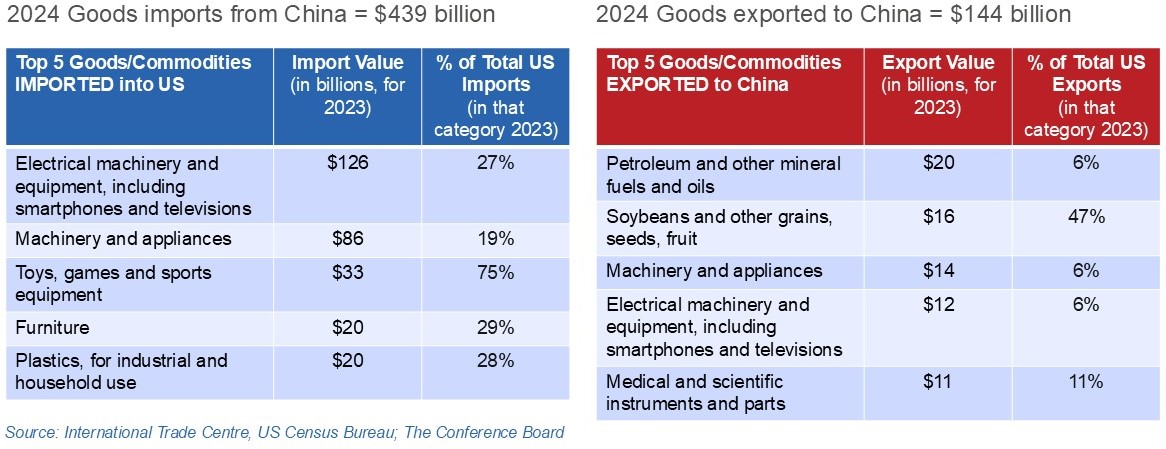
The US trade war with China escalated this week, with the US setting a tariff rate of 125% on goods imported from China, effective April 9. China retaliated, announcing 84% tariffs on goods it imports from the US. Why China is important: China is a leading trading partner of the US, and 14% of imported goods (measured by value) are sourced from China. US total goods trade with China stood at an estimated $582 billion in 2024, with a trade deficit of $295 billion, which is 5.8% greater than 2023. US goods exports to China in 2024 totaled $144 billion, down 2.9% from 2023. US goods imports from China in 2024 totaled $439 billion, up 2.8% from 2023. It is notable that US trade with China has declined over the past six years, down 12% since 2018. The TCB take: Consumer prices will escalate. With bilateral tariff rates between 80-125%, it is certain costs will be passed onto consumers. The leading goods imported from China include electrical items (e.g. smartphones and televisions), as well as machinery and appliances, toys, furniture, and plastics, including components of automobiles. For four of the top five product types imported from China, more than a quarter of those products imported into the US are from China (see table below). US farmers to be hit hard: A whopping 47% of US soybeans and related agriculture products exported by the US went to China. This is a downward trend, as China has increasingly turned to Brazil and other countries in recent years. These new tariffs could drastically reduce China’s dependence on US soybeans, and cripple that agricultural sector, which is primarily in Illinois, Iowa, Minnesota, and Indiana. The Administration and lawmakers are reportedly discussing farm aid in light of these retaliatory tariffs.US-China Trade Hinges on Electronics, Soybeans

myTCB® Members get exclusive access to webcasts, publications, data and analysis, plus discounts to events.
Retail Sales Signal Healthy Q3 Consumer Spending
October 15, 2026
Hotter-than-Expected September CPI Reopens October Hike Debate
October 14, 2026
August PCE Portends Further Hikes Remain Likely
September 30, 2026
September Rate Hike: Not a One and Done
September 16, 2026
August CPI Suggest September Fed Hike
September 11, 2026
Charts
Reducing the deficit leads to lower interest rates and lower costs.
LEARN MORE
Charts
A secure, credible, and accessible electoral system fosters business confidence, enabling companies to trust governance and engage in shaping policy.
LEARN MORE
Charts
As a visual explainer of CED's Solutions Brief, this infographic highlights key design elements for a bipartisan fiscal commission.
LEARN MORE
Charts
As a visual explainer of our Solutions Brief, this infographic outlines The CEO Center's policy priorities for 2026.
LEARN MORE
Charts
The proliferation of easy-to-use generative AI requires that policymakers and business leaders each play an important role.
LEARN MORE
Charts
A hyperpolarized environment, diminished trust in our nation’s leaders.
LEARN MORE
PRESS RELEASE
CED Outlines 2026 Policy Priorities Ahead of Nation’s 250th Anniversary
January 20, 2026
IN THE NEWS
Denise Dahlhoff on How CEOs Are Talking About Tariffs—without Saying “Tarif…
May 21, 2025
IN THE NEWS
Erin McLaughlin on Tariff Policy
April 07, 2025
IN THE NEWS
Erin McLaughlin on Reshoring Factors
April 05, 2025
IN THE NEWS
Erin McLaughlin on US Reshoring
April 02, 2025
IN THE NEWS
Erin McLaughlin: How policy uncertainty may exacerbate infrastructure chall…
March 19, 2025