29 July 2026 / Backgrounder
 Email
Email Linkedin
 Facebook
 X
X Copy Link
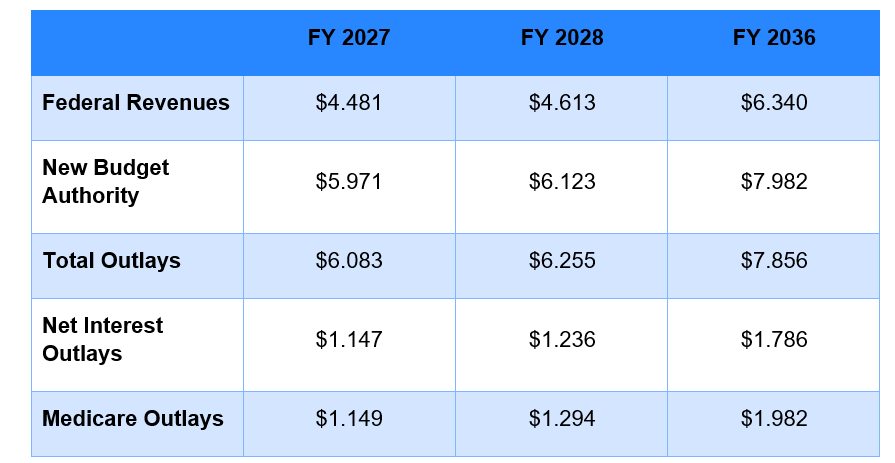
House Republicans have passed a budget resolution to guide a third reconciliation bill. The budget resolution shows Federal outlays, deficits, and the national debt all continuing to increase significantly, with spending on interest expected to pass Medicare spending in fiscal year 2027. Under the Congressional Budget and Impoundment Control Act of 1974, the budget resolution is the first step in Congress preparing and enacting the annual budget for each fiscal year. While informal work has begun on the 12 appropriations bills, the budget resolution gives actual budget allocations to each relevant Congressional Committee to guide its work in preparing an individual appropriations bill. Importantly, the budget resolution must also present a picture of the Federal government’s fiscal outlook for the decade ahead. The House budget resolution uses House Budget Committee estimates of the impact of H.R. 1, also known as the One Big Beautiful Bill Act, rather than estimates from the nonpartisan Congressional Budget Office (CBO). Even on this optimistic presentation, the budget resolution shows rising Federal outlays, deficits, and debt.1 Additional spending would worsen these assumptions. Budget Resolution Estimates for Select Fiscal Years (Trillions) Source: House Budget Committee, Establishing the congressional budget for the United States Government for fiscal year 2027 and setting forth the appropriate budgetary levels for fiscal years 2028 through 2036, July 18, 2026. The above table presents the estimates for revenues, budget authority, and outlays in the House budget resolution. The figure for net interest outlays is significant: while interest on the national debt has already passed defense spending, this estimate shows that net interest will also meet or exceed spending on Medicare over the course of the next two fiscal years. Other spending, higher payments on interest, or higher Medicare spending could accelerate this timeline. These figures, of course, have a direct and predictable impact on deficits and the deficit. The “on-budget” deficit (essentially, excluding Social Security and the Postal Service) is estimated at $1.602 trillion for FY 2027 and $1.641 trillion for FY 2028. The estimated deficit remains at $1.516 trillion in FY 2036. This raises the national debt to $41.359 trillion in FY 2027 and $43.175 trillion in FY 2028, with the debt rising to an estimated $56.170 trillion in FY 2036 (the budget resolution does not estimate GDP and thus does not give the debt as a percentage of GDP). Because the One Big Beautiful Bill Act raised the debt ceiling to $41.1 trillion, it seems likely there will be another debt ceiling limit reached at some point in the middle of 2027.2 The budget resolution also provides additional funding for defense, intelligence, farm assistance, and election administration changes. The resolution includes $60 billion for the Committee on Armed Services and $13 billion for the Permanent Select Committee on Intelligence for military and intelligence operations. This is intended to increase military readiness, strengthen the defense industrial base, and replenish US weapons stockpiles.3 The budget resolution’s $73 billion in military and intelligence is in line with the Administration’s supplemental funding request related to the Iran war, though it is less than the $350 billion the Administration proposed for FY 2027 for defense to be enacted through a reconciliation bill. The second component is $12 billion for the Committee on Agriculture for farm assistance.4 This amount is similar to the amount the Administration proposed in its supplemental funding request on June 24. The final component is $10 billion for the Committee on House Administration, which handles election-related matters. This funding is intended to fund a grant program that provides incentives for states to implement the election administration provisions of the SAVE America Act, such as requiring presentation of a government ID to cast a ballot.5 This provision attempts to comply with reconciliation rules in the Senate, where any amendments to a reconciliation bill are subject the “Byrd Rule” to exclude amendments in areas that are “extraneous” (not germane) to the budget. However, this strategy may not be enough to satisfy Senate rules, and the Senate Parliamentarian will only rule on specific bill text in the Senate. The House passed the resolution by a 216-214 vote.6 The budget resolution now heads to the Senate, where it may face pressure from Senators who want to further increase defense spending and farm aid and deficit hawks concerned about the lack of offsets.7 The Senate is scheduled to go on recess starting on August 10, meaning Senators have fewer than two weeks to consider the resolution. As such, there is likely not enough time for the budget resolution to pass the Senate before the August recess. Arguably, the passage of the House budget resolution marginally decreases the likelihood of a government shutdown at the end of September. The House also passed a continuing resolution funding the Federal government at existing FY 2026 levels through December 4, 220-205.8 The CR relieves some of the pressure of a government shutdown until after the November midterm elections.9 However, some Senators may wish to prioritize the appropriations bills before addressing the budget resolution passed by the House, suggesting challenging negotiations between the House and Senate in September after Congress returns from recess.10 The budget resolution signals that House Republicans are responsive to the Administration’s request for increased defense spending, already the largest discretionary spending line item in the budget. Approving the higher spending without offsets or a comprehensive assessment of the Federal budget would continue the unsustainable rise in the deficit and national debt. If investors begin to view US debt as riskier, interest rates could rise further, increasing borrowing costs for business expansion, hiring, and investment. Should the reconciliation bill be enacted, it would be positive for the defense industry and for US farmers. However, final decisions on defense and agriculture may have to await enactment of the full FY 2027 budget.
Trusted Insights for What’s Ahead®
Baseline Assumptions from the House Resolution
Supplemental Funding
Next Steps in the Senate
Another Shutdown?
Rising Debt’s Implications for Business