Email
Email
 Linkedin
 Facebook
 X
X
 Copy Link
An aggregate of eight labor-market indicators that shows underlying trends in employment conditions. Data series: 1973 – present.
The Conference Board Employment Trends Index™ (ETI) Edged Up Again in February
Latest Press Release
Updated: Monday, March 9, 2026
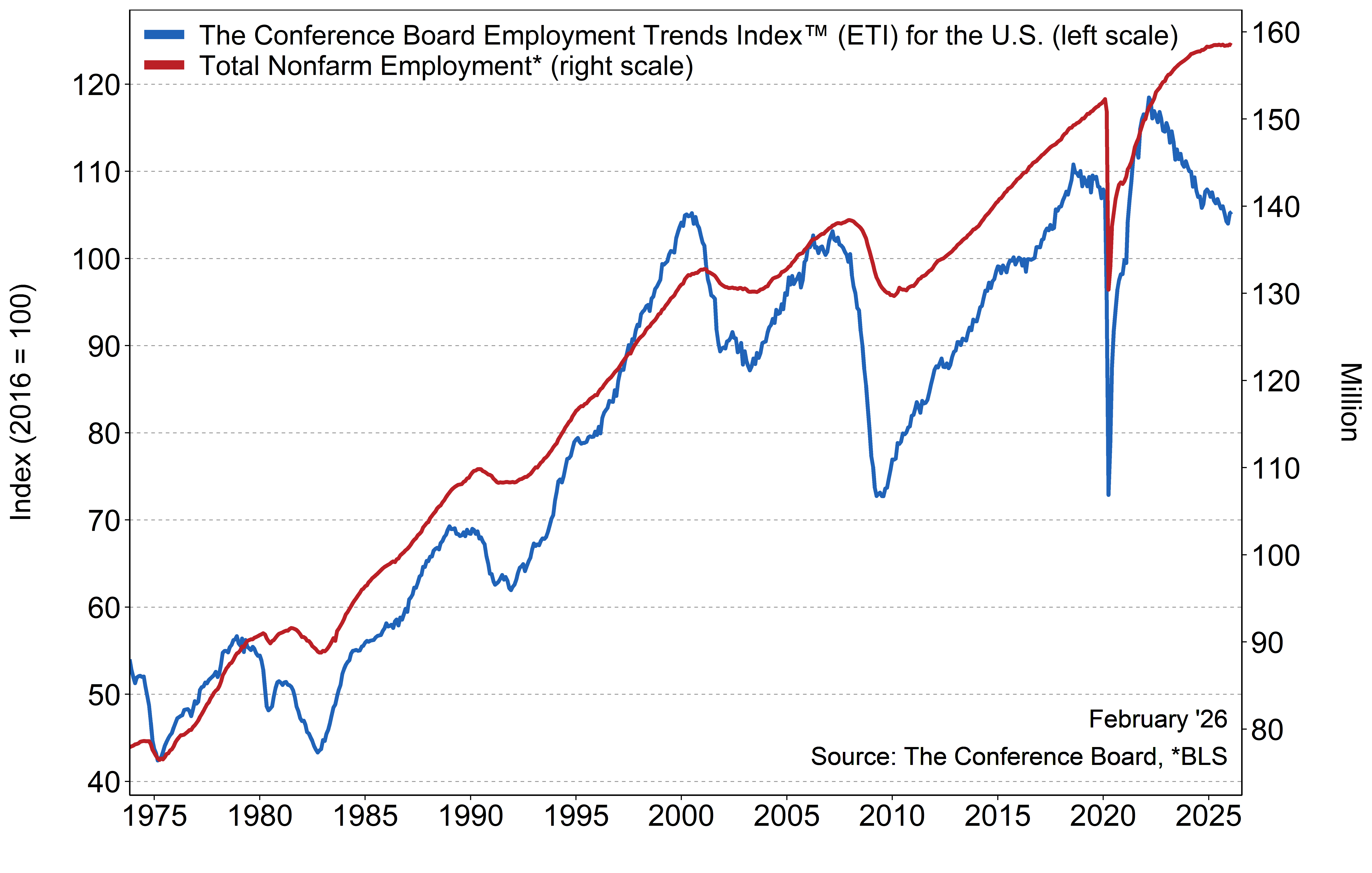
The Conference Board Employment Trends Index™ (ETI) rose marginally in February to 105.37, from an upwardly revised 105.18 in January. The Employment Trends Index is a leading composite index for payroll employment. When the Index increases, employment is likely to grow as well, and vice versa. Turning points in the Index indicate that a change in the trend of job gains or losses is about to occur in the coming months.
“Despite a weak February Jobs Report, the ETI continued to show some resilience,” commented Mitchell Barnes, Economist at The Conference Board. “February’s 92,000 decline in BLS payrolls—while not a direct ETI input—were affected by temporary factors from weather and strikes. Overall, job creation is low but the labor market remains roughly in-balance due to slower labor force growth.”
The share of involuntary part-time workers (an ETI component) declined to 16.2% in February, and was the largest positive ETI contributor for the second consecutive month, with the ratio falling from 19.4% in December. The share of small firms reporting that jobs are ‘not able to be filled right now’ also improved to 33% after reaching a post-pandemic low of 31% in January.
“Six of the ETI’s eight components contributed negatively in February,” Barnes added. “That was a reversal from January when seven components were positive. Mixed signals may persist as businesses and consumers wade through ongoing policy uncertainty.”
The share of consumers who report “jobs are hard to get”—an ETI component from the Consumer Confidence Survey®—rose to 20.6% in February to reach the highest point since early 2021. Initial claims for unemployment insurance ticked up in February following a steady decline since September. Employment in the temporary help services industry declined in February after gains in two of the three prior months. Industrial production and real manufacturing and trade sales also ticked down.
February’s increase in the Employment Trends Index was a result of positive contributions from two of its eight components: the Ratio of Involuntarily Part-time to All Part-time Workers and the Percentage of Firms with Positions Not Able to Fill Right Now. Six components contributed negatively: the Percentage of Respondents Who Say They Find ‘Jobs Hard to Get, Initial Claims for Unemployment Insurance, Job Openings, the Number of Employees Hired by the Temporary-Help Industry, Real Manufacturing and Trade Sales, and Industrial Production.
The Conference Board Employment Trends Index ™, November 1973 to Present
The eight leading indicators of employment aggregated into the Employment Trends Index include:
- Percentage of Respondents Who Say They Find “Jobs Hard to Get” (The Conference Board Consumer Confidence Survey®)
- Initial Claims for Unemployment Insurance (U.S. Department of Labor)
- Percentage of Firms with Positions Not Able to Fill Right Now (© National Federation of Independent Business Research Foundation)
- Number of Employees Hired by the Temporary-Help Industry (U.S. Bureau of Labor Statistics)
- Ratio of Involuntarily Part-time to All Part-time Workers (BLS) ?
- Job Openings (BLS)**
- Industrial Production (Federal Reserve Board)*
- Real Manufacturing and Trade Sales (U.S. Bureau of Economic Analysis)***
*Statistical imputation for the recent month
**Statistical imputation for two most recent months (due to data release delays)
***Statistical imputation for three most recent months (due to data release delays)
? Note missing October 2025 value for Ratio of Involuntarily Part-time Workers estimated using linear interpolation
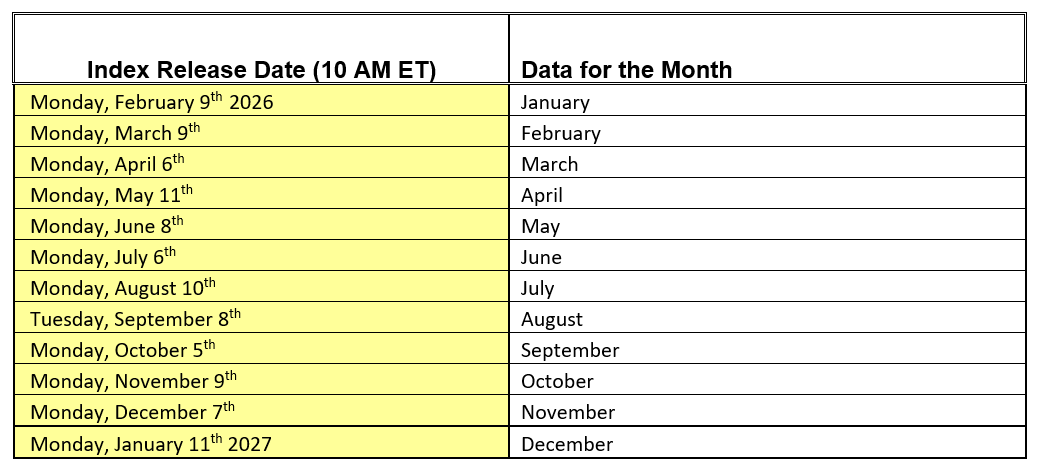
The Conference Board publishes the Employment Trends Index monthly, at 10 a.m. ET, on the Monday that follows each Friday release of the Bureau of Labor Statistics Employment Situation report. The technical notes to this series are available on The Conference Board website: http://www.conference-board.org/data/eti.cfm.
About The Conference Board
The Conference Board is the member-driven think tank that delivers Trusted Insights for What’s Ahead®. Founded in 1916, we are a non-partisan, not-for-profit entity holding 501 (c) (3) tax-exempt status in the United States. www.conference-board.org.
|
Employment Trends Index (ETI)™ 2026 Publication Schedule |