Email
 Linkedin
 Facebook
 X
 Copy Link



For Release 9:30 AM ET, November 18, 2026
Using the Composite Indexes: The Leading Economic Index (LEI) provides an early indication of significant turning points in the business cycle and where the economy is heading in the near term. The Coincident Economic Index (CEI) provides an indication of the current state of the economy. Additional details are below.
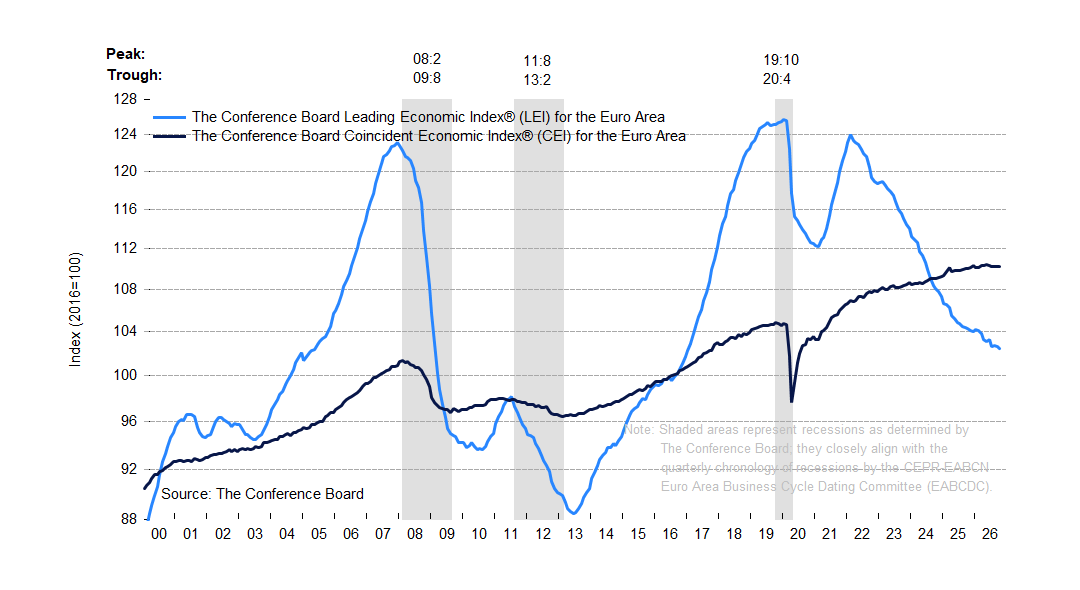
The Conference Board Leading Economic Index®(LEI) for the Euro Area ticked down by 0.1% in October 2026 to 102.5 (2016=100), after also decreasing by 0.1% in September. Due to monthly declines in five out of the past seven months, the LEI fell by 0.8% over the six-month period ending in October 2026. This is a slightly slower pace of retreat than the 1.0% contraction experienced over the previous six-month period (October 2025 to April 2026).
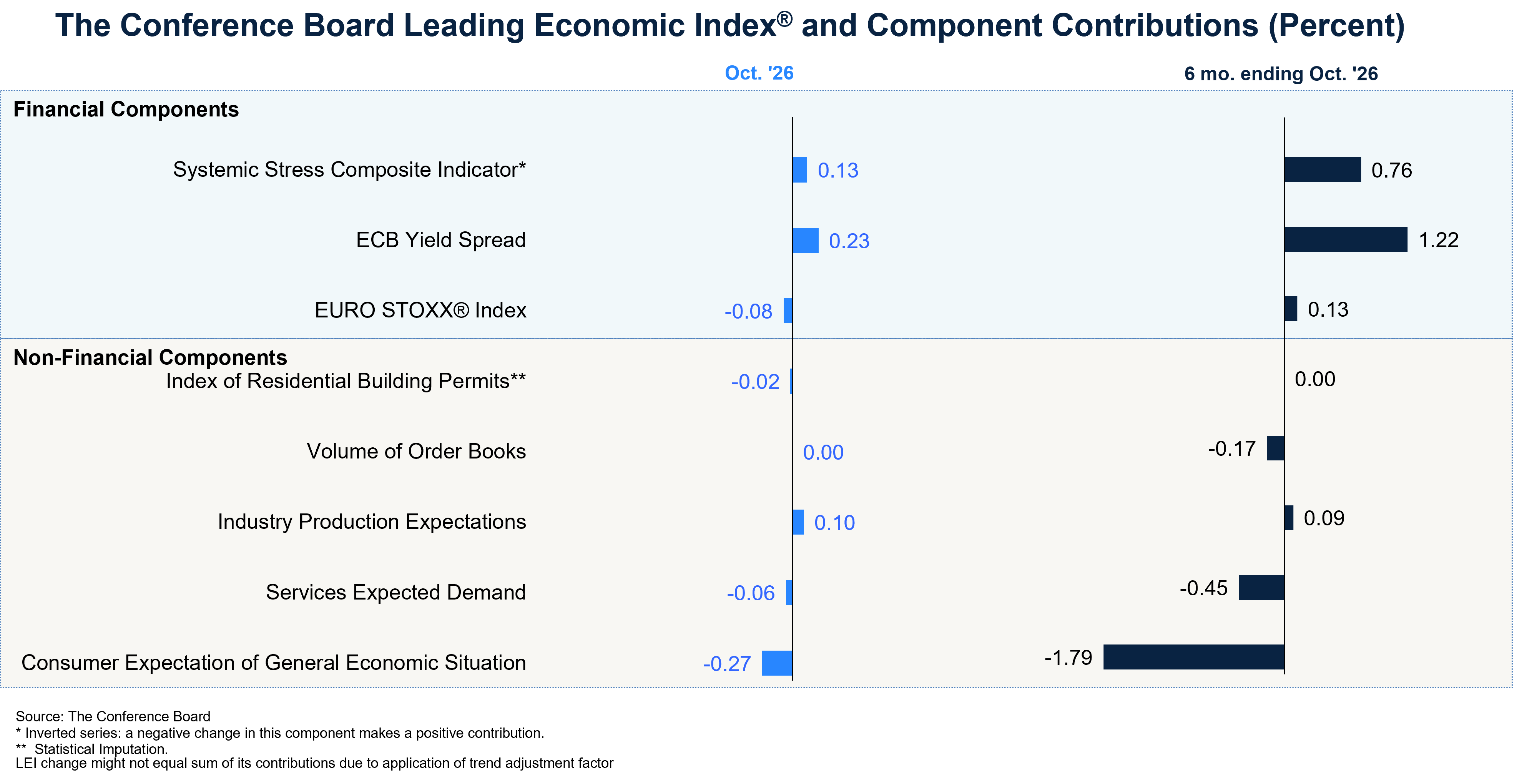
“The Euro Area LEI declined for the fifth time in the last seven months,” said Timothy Brennan, Economic Research Associate, at The Conference Board. “As in previous months, the consumer expectations component was the main drag on the Index. A fall in stock prices and lower expectations from businesses in the service sector also contributed to the monthly drop. However, positive contributions from the remaining financial components and industrial producer expectations helped mitigate the decline.
“The 6-month growth rate of the Euro Area LEI, while marginally improved, remained negative, signaling pressure on economic activity ahead,” continued Brennan. “Energy prices remain elevated, due in large part to supply chain disruptions stemming from the war in the Middle East. Euro Area inflation accelerated to 4.0% y/y in October, its highest level since September 2023, with energy prices increasing by 20.8% y/y. Consumer expectations and expected demand among service businesses remained well below their respective historical averages. Intensifying inflationary forces are likely to prolong this weakness, placing further downward pressure on the Euro Area LEI.
“The widening ECB yield spread provided a positive contribution to the Index. However, rising long-term bond yields may partly reflect growing fiscal and political uncertainty, particularly in France. While German government bond yields have remained relatively insulated, widening sovereign risk premiums in France and other Euro Area economies warrant close monitoring in the coming months. The Conference Board anticipates real GDP in the Euro Area to grow by 1.2% in 2026, and by the same rate for 2027.”
The Conference Board Coincident Economic Index® (CEI) for the Euro Area remained unchanged in October 2026 at 110.2 (2016=100), after being unchanged in September. The CEI contracted by 0.1% over the six-month period from April to October 2026, partially reversing the 0.3% growth observed over the previous six-month period.
The next release is scheduled for Wednesday, December 16, 2026, at 9:30 A.M. ET.
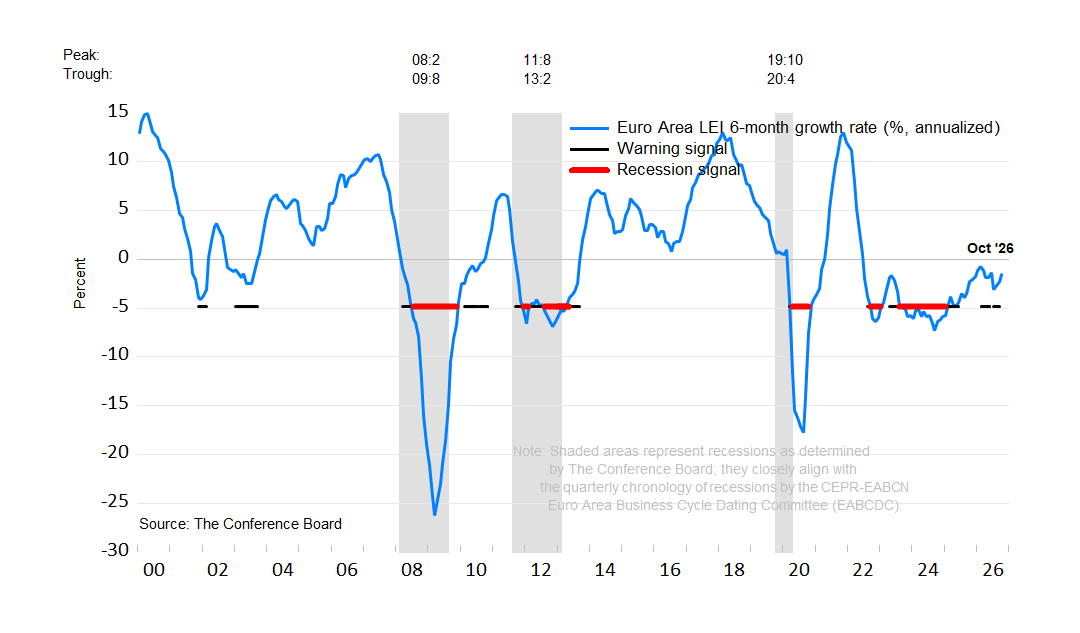
NOTE: The chart illustrates the so-called 3Ds—duration, depth, and diffusion—for interpreting a downward movement in the LEI. Duration refers to how long the decline has lasted. Depth denotes the size of decline. Duration and depth are measured by the rate of change of the index over the most recent six months at an annualized rate. Diffusion is a measure of how widespread the decline is among the LEI’s component indicators—on a scale of 0 to 100, a diffusion index reading below 50 indicates most components are weakening.
The 3Ds rule signals an impending recession when: 1) the six-month diffusion index lies at or below 50, shown by the black warning signal lines in the chart; and 2) the LEI’s six-month growth rate (annualized) falls below the threshold of −5.6%. The red recession signal lines indicate months when both criteria are met simultaneously—and thus that a recession is likely imminent or underway.
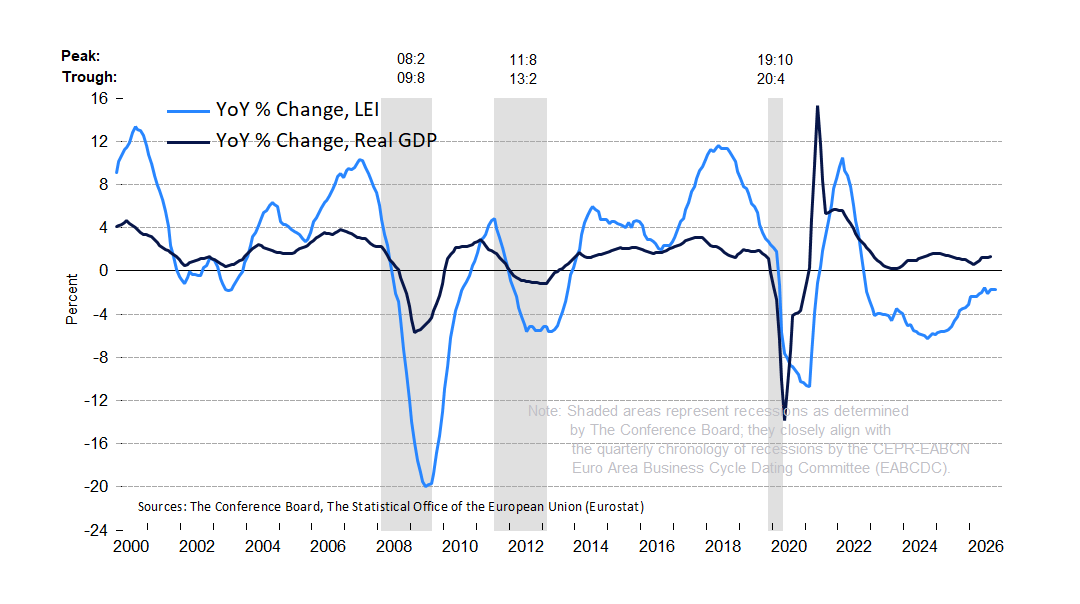
The composite economic indexes are key elements in an analytic system designed to signal peaks and troughs in the business cycle. Comprised of multiple independent indicators, the indexes are constructed to summarize and reveal common turning points in the economy in a clearer and more convincing manner than any individual component.
The CEI reflects current economic conditions and is highly correlated with real GDP. The LEI is a predictive tool that anticipates—or “leads”—turning points in the business cycle by around seven months.
The eight components of Leading Economic Index® for the Euro Area are:
The four components of the Coincident Economic Index® for the Euro Area are:
To access data, please visit: https://www.conference-board.org/data
About The Conference Board
The Conference Board is the Member-driven think tank that delivers Trusted Insights for What's Ahead®. Founded in 1916, we are a nonpartisan, not-for-profit organization holding 501 (c) (3) tax-exempt status in the United States. TCB.org l Learn about Membership
PRESS RELEASE
LEI for Mexico Remained Unchanged in October
November 18, 2026
PRESS RELEASE
The LEI for Germany Dipped Slightly in September
November 17, 2026
PRESS RELEASE
The LEI for France Ticked Down in September
November 16, 2026
PRESS RELEASE
The LEI for the UK ticked down in September
November 13, 2026
PRESS RELEASE
LEI for Brazil inched up in October
November 13, 2026
PRESS RELEASE
LEI for Australia Unchanged in September
November 12, 2026
All release times displayed are Eastern Time

October 29, 2026 | Report
October 29, 2026 | Database
Business & Economics Portfolio
September 30, 2026 | Database
The Economy Stabilized in August but Outlook Remains Weak
September 27, 2023 | Report
China's Economic Recovery Continues to Stutter (Economy Watch: China View, June 2023)
June 30, 2023 | Report
Leading Economic Indicators and the Oncoming Recession
December 07, 2022 | Article

The Evolving Economic Outlook for Europe
July 10, 2024
Is a Global Recession on the Horizon?
July 13, 2022