Email
Email
 Linkedin
 Facebook
 X
X
 Copy Link



For Release 9:00 AM ET, January 28, 2026
Using the Composite Indexes: The Leading Economic Index (LEI) provides an early indication of significant turning points in the business cycle and where the economy is heading in the near term. The Coincident Economic Index (CEI) provides an indication of the current state of the economy. Additional details are below.
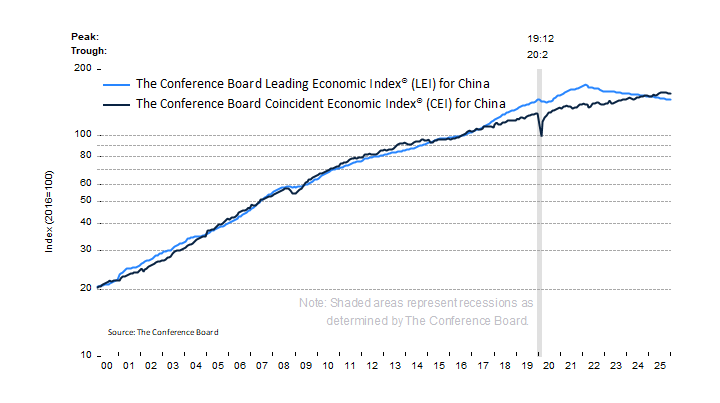
The Conference Board Leading Economic Index®(LEI) for China ticked down by 0.1% in December 2025 to 145.3 (2016=100), after decreasing by 0.2% in November. As a result, the LEI contracted by 1.8% over the second half of 2025, after declining by 1.9% over the previous first half (December 2024 to June 2025).
The Conference Board Coincident Economic Index® (CEI) for China declined by 0.7% in December 2025 to 154.1 (2016=100), after decreasing by 0.9% in November. The CEI contracted by 0.6% in the second half of 2025, in contrast to the growth (1.8%) observed in the first half.
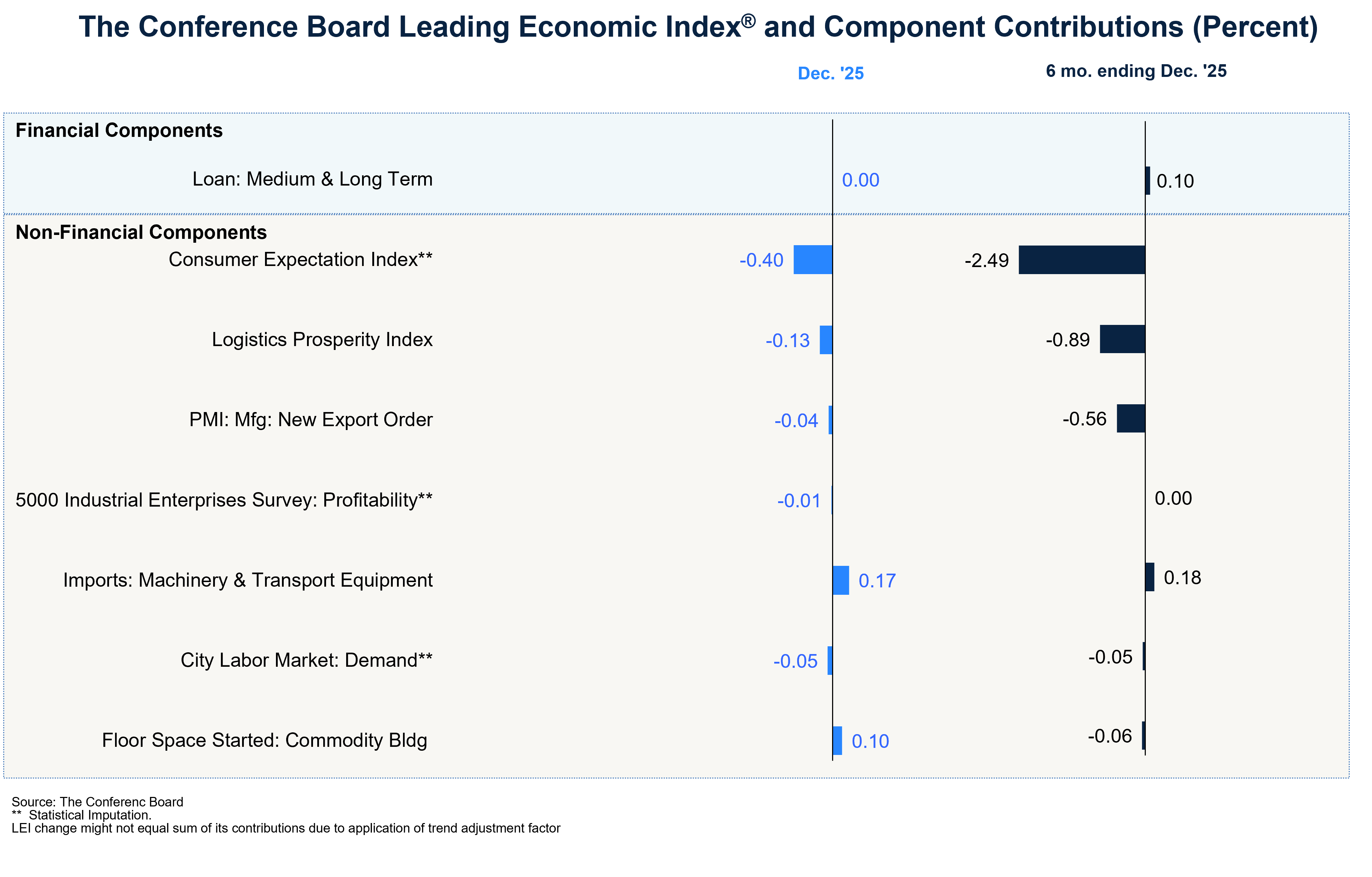
“The China LEI declined on a month-on-month and six-month basis in December, continuing its downward trend,” said Timothy Brennan, Economic Research Associate, at The Conference Board. “Consumer confidence continued to be the primary drag on the index, while the logistics prosperity index also recorded a notable negative contribution. Meanwhile, growth in imports and transportation equipment and building construction bolstered the index, but not enough to offset widespread weakness in all remaining components.
“With the negative semi- and annual-growth rates of the LEI pointing to headwinds and the 6-month diffusion index remaining below 50, the recession signal was triggered again in December,” continued Brennan. “The demand-side of the economy remains soft, due to slowing growth of both retail sales and fixed asset investment. Meanwhile, exports continue to underpin overall growth, supported by strong shipments to the EU and emerging markets. Taking into account downward pressures, The Conference Board currently forecasts annual real GDP growth to slow to 4.5% in 2026.”
Note for Change in Annual BCI Benchmark Revision Timing
Annual BCI Benchmark Revisions
Release of the annual benchmark revisions for Business Cycle Indicator (BCI) composite economic indexes will be moved from January 2026 to June 2026. Releases in subsequent years will also be in June. This modification ensures that the sample period fully incorporates the most recent completed calendar year of the underlying components (source data) of composite indexes (leading and coincident). This data is used for calculating standardization factors and subsequently trend adjustments.
Due to the change in revision release timing from January to June, the cutoff for incorporating source data revisions into the benchmark process will shift accordingly:
- For the next benchmark revision in June 2026, the cutoff used for calculating standardization factors and trend adjustment will be December 2025, rather than December 2024.
- This change in timing allows the volatility calculations and factor updates to reflect a more complete dataset prior to the annual recalculation of the historical composite indexes.
The next release is scheduled for Wednesday, February 25, 2026, at 9:00 A.M. ET
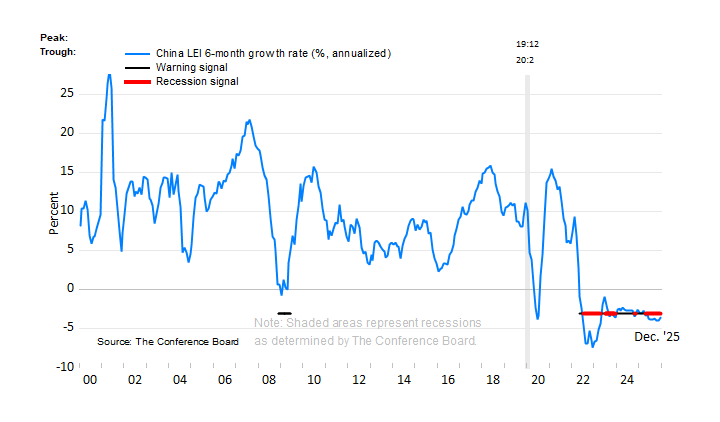
NOTE: The chart illustrates the so-called 3Ds—duration, depth, and diffusion—for interpreting a downward movement in the LEI. Duration refers to how long the decline has lasted. Depth denotes the size of decline. Duration and depth are measured by the rate of change of the index over the most recent six months at an annualized rate. Diffusion is a measure of how widespread the decline is among the LEI’s component indicators—on a scale of 0 to 100, a diffusion index reading below 50 indicates most components are weakening.
The 3Ds rule signals an impending recession when: 1) the six-month diffusion index lies at or below 50, shown by the black warning signal lines in the chart; and 2) the LEI’s six-month growth rate (annualized) falls below the threshold of −2.8%. The red recession signal lines indicate months when both criteria are met simultaneously—and thus that a recession is likely imminent or underway.
About The Conference Board Leading Economic Index® (LEI) and Coincident Economic Index® (CEI) for China
The composite economic indexes are key elements in an analytic system designed to signal peaks and troughs in the business cycle. Comprised of multiple independent indicators, the indexes are constructed to summarize and reveal common turning points in the economy in a clearer and more convincing manner than any individual component.
The CEI reflects current economic conditions and is highly correlated with real GDP. The LEI is a predictive tool that anticipates—or “leads”—turning points in the business cycle by around five months.
The eight components of the Leading Economic Index® for China are:
The four components of the Coincident Economic Index® for China are:
To access data, please visit: https://data-central.conference-board.org/
About The Conference Board
The Conference Board is the member-driven think tank that delivers Trusted Insights for What’s Ahead®. Founded in 1916, we are a non-partisan, not-for-profit entity holding 501 (c) (3) tax-exempt status in the United States. Tcb.org
PRESS RELEASE
LEI for India Ticked Down in December
January 26, 2026
PRESS RELEASE
The LEI for France Ticked Up in November
January 22, 2026
PRESS RELEASE
LEI for Mexico Ticked Down in December
January 21, 2026
PRESS RELEASE
LEI for the Euro Area Declined in December
January 21, 2026
PRESS RELEASE
The LEI for Germany Increased in November
January 20, 2026
PRESS RELEASE
The LEI for the UK ticked down in November
January 16, 2026
All release times displayed are Eastern Time
Note: Due to the US federal government shutdown, all further releases for The Conference Board Employment Trends Index™ (ETI), The Conference Board-Lightcast Help Wanted OnLine® Index (HWOL Index), The Conference Board Leading Economic Index® of the US (US LEI) and The Conference Board Global Leading Economic Index® (Global LEI) data may be delayed.

Business & Economics Portfolio
December 23, 2025 | Database
December 16, 2025 | Database
December 16, 2025 | Report
The Economy Stabilized in August but Outlook Remains Weak
September 27, 2023 | Report
China's Economic Recovery Continues to Stutter (Economy Watch: China View, June 2023)
June 30, 2023 | Report
Leading Economic Indicators and the Oncoming Recession
December 07, 2022 | Article

The Evolving Economic Outlook for Europe
July 10, 2024
Is a Global Recession on the Horizon?
July 13, 2022