27 October 2026 / Report
 Email
 Linkedin
 Facebook
 X
 Copy Link
Public support for capitalism remains high, but what does recent polling reveal about the future of the American economy?
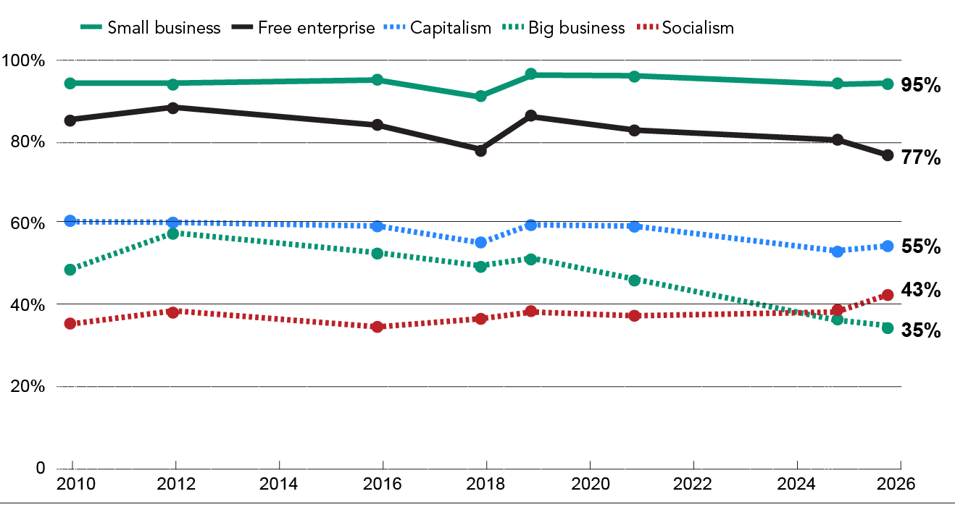
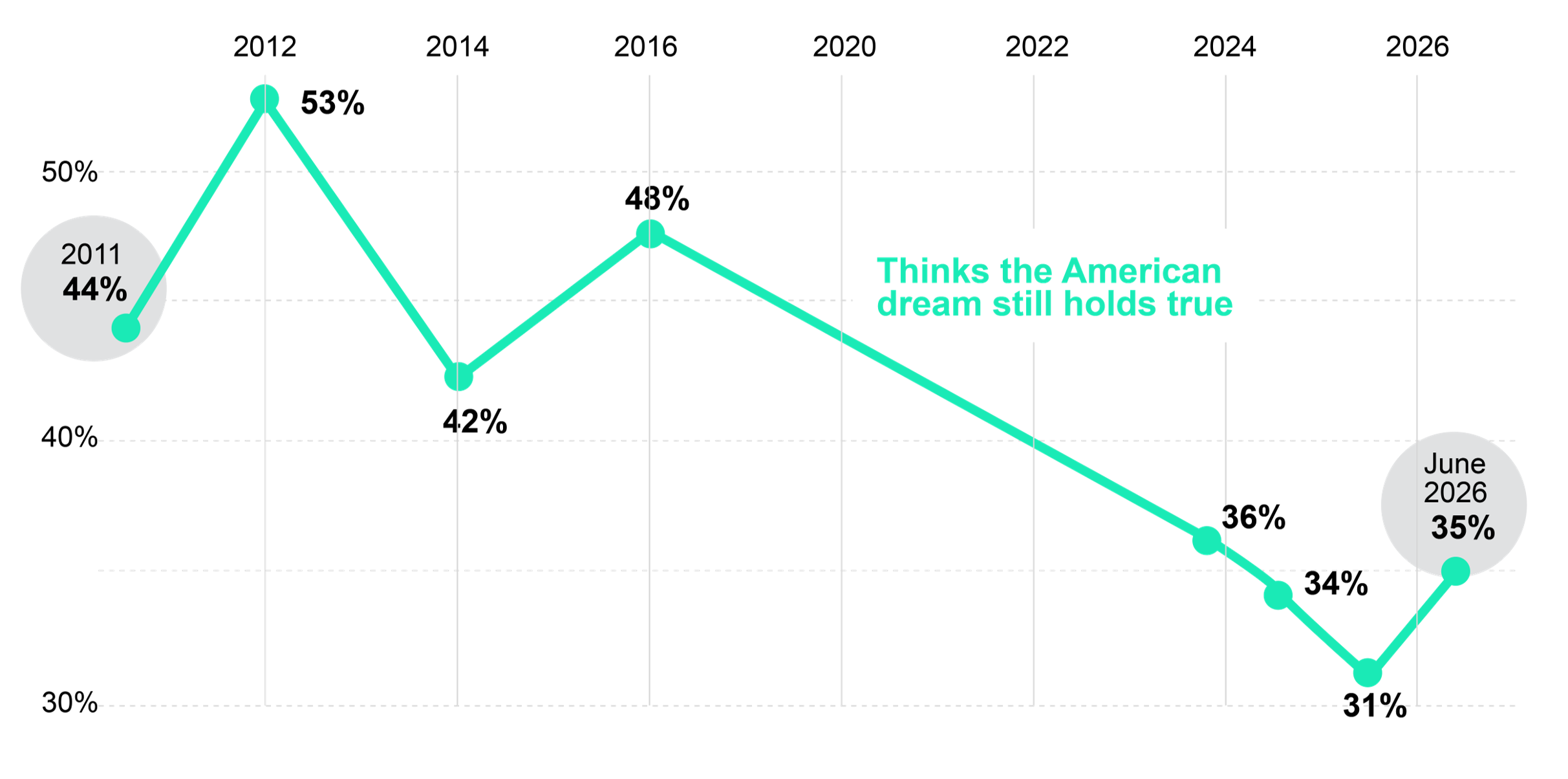
learn moreAmericans remain strongly supportive of free enterprise and small business, but attitudes toward “capitalism” have declined amid growing concern that its benefits are not widely accessible. As emerging technologies reshape work, this decline has implications for business formation, talent pipelines, US global competitiveness, and consumer behavior. Building confidence will require increasing awareness of the opportunities a free enterprise system offers while expanding access to entrepreneurship, innovation, and business ownership. Building confidence in the US economic system will require more than increasing public awareness of the opportunities it can provide. Schools, communities, government, and the private sector each has a distinct role in taking actionable steps to make entrepreneurship and business ownership more accessible. Expand entrepreneurship education and work-based learning Young people are more likely to view entrepreneurship as a realistic path when classroom instruction is paired with hands-on opportunities to design, establish, and operate a business. Engage the private sector Business leaders can make the idea of entrepreneurship more attainable by sharing their experience, providing mentorship, and connecting aspiring business owners with professional networks and resources. Strengthen state and federal programs supporting business formation State and federal programs can help prospective entrepreneurs secure financing, navigate regulatory requirements, receive technical assistance, and maintain health insurance coverage while transitioning from traditional employment. Regular evaluations should assess whether these programs reach the most promising entrepreneurs and contribute to sustainable business formation. Since 2010, Gallup has measured Americans’ views of capitalism, socialism, free enterprise, small business, and big business. Its latest findings continue to reinforce an important distinction: although positive views of “capitalism” have declined from 61% in 2010 to 55% in 2026, Americans remain strongly positive toward free enterprise and small business.2 In 2026, 77% said they viewed “free enterprise” positively and 95% viewed “small business” positively. The results suggest that Americans do not reject the principles associated with capitalism, including opportunity, entrepreneurship, competition, innovation, and economic freedom. Figure 1 Americans’ views of common economic concepts % positive Source: Gallup, 2010–2026 The continued appeal of entrepreneurship reinforces this distinction. Americans have long associated small businesses and entrepreneurship with independence, opportunity, innovation, and benefits to the community. For many, starting or supporting a business represents a tangible way to exercise economic freedom and build a better future. This practical connection may help explain why support for “free enterprise” and “small business” remains considerably stronger than support for “capitalism” as a broad economic label. Views of capitalism also differ sharply along party and generational lines.3 In 2026, 35% of Democrats said they viewed “capitalism” positively, down from 42% the year before. Independents were more favorable at 56%, while Republicans remained strongly positive at 75%. Age differences were similarly pronounced: adults aged 18–34 viewed “socialism” more favorably than “capitalism,” 57% vs. 43%; adults aged 35–54 rated the two systems about equally; and adults 55 and older favored capitalism by a wide margin, 65% vs. 34. Age differences may reflect different perceptions of perceived benefits of the system and a desire for access to more benefits provided by government. A July 2026 Fox News poll of registered voters echoes Gallup’s findings: 50% viewed capitalism favorably, down from 57% in 2019.4 Socialism remained broadly unpopular, though climbing to 30% favorable from 25% in 2019. Economic pressures likely contribute to this shift. The Federal Reserve’s 2025 Survey of Household Economics and Decisionmaking found that while 73% of adults reported doing at least reasonably well financially, more than 9 in 10 said price increases remained a major or minor concern.5 Gallup’s April 2026 Economy and Finance survey similarly found that the high cost of living continues to top Americans’ list of the most important financial problems facing their families, with 31% citing it in an open-ended question.6 While the figure is below the 41% peak recorded in 2024, it remains similar to the prior year and among the highest levels in over 20 years of polling on the issue. Gallup’s December 2025 open-ended survey helps explain why Americans strongly support free enterprise while expressing concern about capitalism.7 Respondents praised capitalism for aspects related to personal opportunity and advancement, cited by 35%, followed by the ability to foster innovation, competition, and efficiency, cited by 29%. Free enterprise, by contrast, was associated more closely with economic freedom and open markets: 40% cited economic freedom, consumer choice, and competition, while 26% emphasized innovation and creativity. The largest difference between perceptions of capitalism and free enterprise involved inequality. Nearly one-quarter of Americans, 23%, identified unequal wealth distribution or benefits for the wealthy at the expense of others as a drawback of capitalism, compared with only 9% who expressed the same concern about free enterprise. A June 2026 Wall Street Journal-NORC survey reinforces this conclusion that many Americans are skeptical of how capitalism is functioning.8 The poll found that only 48% of Americans believe capitalism is working very or somewhat well, while 51% say it is not working too well or not working at all. Sadly, it also found just 35% believe the American Dream—the idea that working hard delivers success—remains achievable. Figure 2 Belief in the American Dream has declined overall Source: Aaron Zitner and Rosie Ettenheim, America’s Support for Capitalism Has Declined Over Last Decade, Wall Street Journal, July 8, 2026. These findings reveal a deeper narrative: they suggest that Americans believe in many of capitalism’s core values—free enterprise, business, and entrepreneurship—but are judging the system against a backdrop of institutional strain, heightened polarization, and economic anxiety. The CEO Center has long championed a capitalist system that affords all Americans equal opportunity. This vision is outlined in its book, Sustaining Capitalism: Bipartisan Solutions to Restore Trust and Prosperity, which argues that free enterprise is strongest when paired with competitive, open markets; responsible business practices; and policies that promote broad-based prosperity. Restoring confidence in capitalism requires not only strengthening the conditions that allow more Americans to participate and benefit but also increasing awareness of how to pursue entrepreneurship and business ownership—giving more people the knowledge and confidence to participate fully in the system. Free enterprise, a system in which private businesses are able to compete with each other with little control by the government, is built on private ownership, voluntary exchange, competition, and limited government control over business decisions. In practice, free enterprise allows individuals and businesses to start companies, invest, hire, sell goods and services, and compete in the marketplace under clear rules and property rights. When it works well, free enterprise encourages competition, attracts investment, rewards innovation, and gives people the access to capital necessary to start businesses for themselves, building their own prosperity and contributing to broader economic growth. The US system of free enterprise has produced one of the most dynamic and resilient economies in the world. With a GDP of roughly $30.8 trillion in 2025, the US remains the world’s largest economy.9 It also ranks as a global leader in innovation: the World Intellectual Property Organization’s 2025 Global Innovation Index ranked the US third out of 139 economies, behind only Switzerland and Sweden, based on 80 indicators measuring innovation inputs and outputs.10 These outcomes are not accidental. They reflect an economic system that has historically rewarded risk-taking, protected property rights, attracted investment, and provided a regulatory environment that allowed new ideas to scale faster than in many other countries. Entrepreneurship: Free enterprise in practice The US also benefits from a deep and resilient culture of entrepreneurial activity. The Global Entrepreneurship Monitor’s (GEM) 2025/2026 United States Report found that nearly 1 in 5 US adults is engaged in early-stage entrepreneurial activity, near historic highs.11 In an economy defined by volatility, uncertainty, and rapid technological change, entrepreneurship has become a core competency for navigating complexity, discerning what can add value, and taking disciplined risks. This sustained level of activity suggests that Americans continue to view new venture creation as a path to opportunity, independence, and impact. At the same time, entrepreneurial momentum does not automatically translate into long-term business success. GEM’s 2025/2026 US report points to a widening gap between new venture creation and business sustainability, with early-stage activity remaining strong even as established business ownership has declined and closures remain elevated.12 Leaving aside effects from the business cycle and the economy, long-term success depends on the ability to build organizations that can consistently deliver value to their customers, employees, and the broader economy. Doing so requires effective risk management, careful capital allocation, and even mentors. AI and other new analytical technologies are also reshaping how entrepreneurs design and implement their business models amid growing challenges. The report also highlights the disparities within US entrepreneurship across groups.13 In 2025, Black and Hispanic Americans reported higher rates of early-stage entrepreneurial activity than White Americans, while smaller shares reported owning and managing established businesses (those that had operated for more than 42 months). Because GEM surveys individuals at a point in time rather than following the same businesses over their life cycles, these findings do not demonstrate higher start-up failure rates. They do, however, suggest that high early-stage participation may not be matched by comparable established-business ownership, warranting closer examination of barriers to long-term success. Declining confidence in capitalism as an economic system stands in contrast with Americans’ positive attitudes toward its core values of free enterprise and small-business formation. Still, this decline has real consequences for businesses, discouraging entrepreneurship and business formation, weakening workforce and talent pipelines, undermining long-term competitiveness, and shaping consumer behavior. Entrepreneurship and business formation Americans have long viewed entrepreneurship as an attractive and rewarding pursuit, but public perception of the ease of starting a business is far less favorable. According to the GEM 2025/2026 US report’s Adult Population Survey, perceptions of entrepreneurial opportunity fell sharply in 2025.14 Just over half of adults, 51.8%, reported seeing good opportunities to start a business in their area, down from 59.3% in 2024. Other indicators of entrepreneurial readiness also showed weakness. Confidence in respondents’ assessment of their own entrepreneurial capabilities remained below levels recorded in earlier years, while fear of failure remained elevated compared with the period before 2020. About half of adults reported knowing an entrepreneur personally, a modest change from 2024 and still below levels recorded between 2019 and 2022. Workforce and talent pipelines Public perceptions of capitalism affect workforce and talent pipelines by shaping whether individuals view businesses as a source of opportunity and economic mobility or as a system that contributes to inequality and distributes rewards unfairly. When perceptions are negative, distrust can extend to individual employers, influencing career choices, employee engagement, and retention. According to research by The Conference Board, organizational mission, values, and purpose are high priorities for members of Gen Z when deciding where to work and whether to remain with an organization. Gen Z workers value a strong sense of purpose in their daily responsibilities and want to understand how their work contributes to the organization’s broader goals. At the same time, many are skeptical of mission and values statements that are not supported by visible action. Employers can strengthen recruitment, engagement, and retention of Gen Z talent by ensuring that managers connect employees’ work to organizational purpose and that organizational leadership demonstrates company values through open communication, transparent decision-making, and investment in employee resources. These expectations are also shaped by whether employment provides a realistic path to financial security. A 2026 survey of Gen Z and millennials found that a majority (69% of Gen Zs and 64% of millennials) say that the availability or affordability of housing has a direct impact on their career decisions and where they can work.15 When young people do not believe that employment will provide access to a stable standard of living or economic mobility, corporate statements about purpose may appear disconnected from their lived experience. Long-term competitiveness US long-term competitiveness depends on technical innovation, workforce skills and global talent, and an attractive environment for investment and business growth. It also depends on public confidence that these systems operate fairly and provide meaningful opportunities for advancement. Pessimism, in contrast, has the potential to reduce the willingness of workers, entrepreneurs, and investors to make long-term commitments to building their futures in the US. Consumer behavior The Conference Board Consumer Confidence Index®, a monthly measure of consumer attitudes, buying intentions, vacation plans, and consumer expectations for inflation, stock prices, and interest rates, has followed a generally downward-sloping trajectory since late 2021. Consumers’ write-in responses on factors affecting the economy remained largely pessimistic in September 2026. References to prices (oil and gas prices in particular) and the high cost of goods and services rose to new heights, reflecting September’s surge in fuel costs. As consumers tighten household budgets and avoid, delay, or reduce purchases, “small treats” stands as a resilient category, providing an attainable way to indulge.16 “Affordable luxuries” allow consumers to experience a sense of reward without the financial strain of a major purchase. After years of economic disruption and rising prices, small indulgences have shifted from occasional treats to a more routine form of consumption.17 This trend is particularly relevant for younger consumers facing uncertainty about their economic futures and feeling that traditional milestones, such as homeownership, seem out of reach. These trends reveal a consumer culture that is increasingly selective, conscious of value, and cautious. For businesses, declining confidence in capitalism, combined with economic uncertainty, can reshape how and where consumers spend. Skepticism toward corporate motives may contribute to delayed purchases, reduced consumption, weaker brand loyalty, and greater support for companies perceived as fair, transparent, and responsible. Building confidence in free enterprise requires more than a public awareness campaign. It requires addressing the barriers prospective entrepreneurs encounter when starting a business. Education, financing, mentorship, and supportive institutions can make business ownership more attainable, but programs providing these resources must be evaluated for their reach and effectiveness. Build economic and entrepreneurial skills “Entrepreneurial Education at School (during K-12)” was the lowest-rated condition in 33 of the 53 economies reviewed in the GEM 2025/2026 Global Report’s National Expert Survey.18 The US received a score of 3.0 out of 10, well below GEM’s threshold of 5.0 for an adequate entrepreneurial environment and down from 4.2 in 2024. Only three middle-income economies (India, Latvia, and Estonia) and seven high-income economies—four in the Gulf (Qatar, Saudi Arabia, United Arab Emirates, and Bahrain) and three in Northern Europe (the Netherlands, Lithuania, and Finland)—reach sufficiency. While entrepreneurship education is included in most K-12 systems across the country, the depth of instruction varies significantly. The Carl D. Perkins Career and Technical Education Act defines career and technical education to include entrepreneurship.19 A 2019 Junior Achievement USA review found that 49 states reported K-12 entrepreneurship standards, guidelines, or proficiencies.20 These standards generally identify concepts that districts should teach, often within economics, social studies, or Career and Technical Education (CTE), rather than requiring a stand-alone entrepreneurship course. Forty-five states reported that a high school entrepreneurship course was available but not required for graduation, while 27 offered entrepreneurship as a topic within a course required for graduation. Far fewer states have built models combining entrepreneurial coursework with the opportunity for actual or simulated business formation, work-based learning that can lead to entrepreneurship, industry-based certifications, and continued employer engagement. Texas has developed one of the most comprehensive high school entrepreneurship pathways.21 Within the state’s Business, Marketing, and Finance Career Cluster, students have the opportunity to follow the Entrepreneurship program of study, focusing on formulating policies, launching businesses or organizations, managing daily operations, analyzing management structures, and planning for the use of materials and human resources. Students are also encouraged to participate in work-based learning, such as interning at a local start-up or business incubator. Completing the sequence also fulfills the requirements for a Business and Industry endorsement on a student’s diploma.22 This endorsement is one of the most popular of those offered by the state: in 2024, 98,805 students—approximately 26% of all Texas public high school graduates—earned the Business and Industry endorsement.23 Indiana high school students can choose among 16 CTE Career Clusters encompassing more than 79 pathways.24 Within the Marketing Cluster, students can participate in the Entrepreneurship pathway, taking introductory business courses before advancing to the Entrepreneurship and New Ventures Capstone.25 In 2026, 138 students graduated via the Entrepreneurship pathway.26 The online modules are designed to cover all aspects of entrepreneurship, from identifying traits of successful entrepreneurs to managing the business, hiring employees, and fostering a company culture, while preparing students for the Entrepreneurship and Small Business certification.27 Indiana connects this coursework to a broader system of employer engagement and experiential learning. Under the state’s Graduation Pathways, students are encouraged to pursue apprenticeships, internships, and other work-based learning opportunities. Indiana provides eligible students in grades 10-12 with up to $5,000 annually through its Career Scholarship Account program to cover costs of approved work-based learning, apprenticeships, internships, and approved postsecondary training.28 Together, these policies help connect entrepreneurship education to certification and real-world experience. Georgia’s Foundational Leadership and Entrepreneurship Experience (FLEX), a community-driven nonprofit initiative, offers an especially direct model of student-led business design and formation. High school students form teams, develop business ideas, and launch and operate actual businesses. In each local competition, 10 selected student companies receive small seed loans and operate for eight to 12 weeks before pitching their businesses to a panel of judges; the top three continue operating for another five weeks before a final presentation. Business partnerships are central to FLEX, with local business leaders serving as mentors, program judges, and sponsorship providers. By connecting school systems with their local business communities, the program seeks to strengthen rural entrepreneurial ecosystems and create practical pathways for students to achieve an entrepreneurial dream. The experience can have a lasting effect beyond winning the competition: although the winner and two runners-up represent just 12% of all students who have competed in FLEX, 59% of participants’ businesses remained in operation as of April 2025.29 Private foundations are another important source of funding for promoting entrepreneurship. For example, the Ewing Marion Kauffman Foundation’s Real World Learning Initiative connects Kansas City-area high schools with businesses and community organizations to provide students with immersive experiences, including internships and client-connected projects. Through these projects, students work alongside professionals from businesses, nonprofits, and community organizations to develop solutions to real-world problems, gaining exposure to different industries while building entrepreneurial and other essential skills. Students can also earn college credit, obtain industry-recognized credentials, and gain work experience valued by employers. Focusing on northeast Ohio, the Burton D. Morgan Foundation30 supports, either itself or working through partnerships, entrepreneurship education, educator training, and experiential learning from K-12 through higher education with the goal of building entrepreneurial mindsets and skill sets to prepare students to navigate complex paths in an unpredictable future. The foundation also directly supports entrepreneurs and second-stage businesses. Similarly, focusing on Oregon, The Lemelson Foundation31 supports regional innovation ecosystems for invention-based businesses by funding incubators and accelerators, strengthening coordination among entrepreneurship organizations, and developing financing solutions that expand access to capital. It also supports university programs that help students develop environmentally responsible inventions and turn promising projects into scalable businesses. Expand access to capital and entrepreneurial support Congress established the Small Business Administration (SBA) in 1953. It supports entrepreneurs by expanding access to capital, providing technical assistance, helping small businesses compete for federal contracting opportunities, and leading disaster recovery efforts for small businesses and communities in need. Central to SBA’s work is supporting entrepreneurs’ access to capital by reducing the risk assumed by private lenders through guaranteed loans. SBA has two major lending programs: 7(a) loans and 504 loans. The 7(a) program is SBA’s primary business loan and provides flexible financing for working capital, equipment, real estate, eligible debt refinancing, or business acquisitions, while the 504 program offers long-term, fixed-rate financing for major fixed assets such as commercial property, buildings, and long-term machinery and equipment. Unlike other major SBA lending programs, the 504 program explicitly connects fixed-asset financing with job creation, job retention, or other approved economic-development objectives.32 At a June 2026 hearing of the House Committee on Small Business, the SBA reported that its Small Business Investment Company program had mobilized $53 billion in combined private capital, the highest level in the program’s 67-year history.33 Approximately 44% of its 2025 portfolio was invested in industrial businesses, including $3 billion directed toward manufacturing, reflecting an increased focus on domestic production and supply-chain resilience. The hearing also emphasized expanding investment beyond the coastal cities and directing capital to rural and underserved communities. SBA’s Made in America Manufacturing Initiative34 and the 2026 Investing in All of America Act35 support this goal by allowing qualifying investments in rural and low-income areas, manufacturing, and critical technologies to be excluded from certain Small Business Investment Company leverage limits. However, access to capital alone is not sufficient. The SBA supports a nationwide network of resource partners that provide counseling and technical assistance to help entrepreneurs develop business plans, access financing, and operate and grow their businesses. At a July 2026 House Committee on Small Business hearing, SBA officials noted these services are most effective when resource partners attract funding beyond the federal government and collaborate with state and local governments, chambers of commerce, and other organizations.36 The hearing also identified significant administrative and oversight challenges, including underperforming centers and approximately $340 million in unpaid grant obligations. SBA officials outlined efforts to improve performance by modernizing financial systems, consolidating grant programs, cross-training staff, and addressing centers that fail to improve. Incubators and accelerators can further complement access to capital by providing entrepreneurs with workspace, expert mentorship, networking, and legal and financial guidance. Incubators generally support entrepreneurs at the earliest stages of business development, when the business model is still being refined.37 Comparatively, small-business accelerators are short, intensive programs for start-ups that have moved beyond the idea stage and are prepared for more rapid growth. These fixed-term programs typically provide mentorship, networking, and sometimes seed financing. Although the models serve businesses at different stages, both can reduce the informational and relational barriers that prevent entrepreneurs from obtaining financing and successfully growing a venture. Boston-based MassChallenge, a nonprofit accelerator that collaborates with public- and private-sector partners, offers a zero-equity program focused on early commercialization and market readiness.38 Through industry-specific programs, MassChallenge connects start-ups with specialized mentorship, founder development programs, a dynamic network of industry connections, and potential investors without requiring founders to surrender an ownership stake. Alumni from the program have raised more than $16 billion in financing, created 77,000 direct jobs, and achieved a 70% survival rate. For perspective, US Bureau of Labor Statistics data show that the national survival rates for new businesses have generally ranged from approximately 50% to 57% within the first five years of operation.39 The figures are not directly comparable because MassChallenge selects growth-oriented start-ups through a competitive process and does not specify a common period for measuring survival. Still, the alumni record illustrates the potential of accelerator models to help promising ventures build connections, attract capital, create jobs, and navigate the difficult transition from formation to growth. A 2022 International Trade Administration analysis found that 40% of US business accelerators were located in three metropolitan areas: Baltimore, Denver, and San Francisco.40 The remaining 60% were somewhat dispersed across the country but were largely concentrated in 28 metropolitan areas, leaving many communities without valuable entrepreneurial infrastructure. Accelerators can produce a spillover effect by strengthening the broader start-up ecosystem in a region, not only those participating in the program. A 2019 study found that establishing an accelerator was associated with increased seed and early-stage funding for start-ups throughout the entire region.41 One possible explanation is that nonlocal investors drawn to accelerator participants also encounter and evaluate other local start-ups, extending access to capital.42 These spillover effects strengthen the case for locally rooted accelerators that connect entrepreneurs with investors, mentors, universities, established businesses, and customers. Expanding this infrastructure into rural and underserved communities is critical to ensuring that geography does not determine an entrepreneur’s access to the capital, expertise, and relationships needed to launch and grow a business. Efforts to expand entrepreneurial infrastructure should reflect the unique strengths of each community. Harvard Business School’s US Cluster Mapping Project defines clusters as regional concentrations of related industries and offers a new perspective on economies and the competitive landscape at the national, state, and local levels.43 State and local leaders can use cluster analysis to identify the assets shaping regional economic performance and align incubators, accelerators, workforce programs, and capital resources with established industries and emerging opportunities. Reduce barriers to business formation A strong business idea, access to capital, and entrepreneurial training may not lead to business formation if prospective entrepreneurs cannot afford to leave the security of traditional employment. Prospective entrepreneurs must weigh the benefits of a new venture with the risks associated with the possible loss of health insurance, retirement contributions, paid leave, and of course, a predictable income. These considerations can make entrepreneurship less attainable, particularly for individuals with dependents, ongoing medical needs, or limited savings. The Affordable Care Act (ACA) Marketplaces disproportionately serve as a source of health insurance coverage for self-employed workers and small-business owners. A 2024 analysis by the US Department of the Treasury found that in 2022, 18% of these individuals ages 21-64 had ACA Marketplace coverage, compared to just 6% of the rest of the population that same age.44 More than 20% of small-business owners and self-employed people had ACA Marketplace coverage in 2022 in the following states: Florida, Georgia, Maine, North Carolina, Nebraska, New Hampshire, South Carolina, Utah, and Wyoming. Efforts to encourage business formation should continue to examine how benefits can remain affordable and accessible during the transition to business ownership. Engage the private sector The private sector has much more to contribute to entrepreneurship growth than capital investment alone. As the Georgia FLEX example illustrates, business leaders can mentor the next generation of entrepreneurs by sharing the practical knowledge gained from building, operating, and leading companies. Employers can partner with schools and community organizations, encourage employees to serve as mentors and guest instructors, partner with high school programs to sponsor student ventures, and take other steps, including offering work experiences and formal apprenticeships that can make business ownership feel tangible and attainable. That same local commitment can help incubators and accelerators take root in communities that lack entrepreneurial infrastructure. Companies can provide facilities, technology, expertise, and introductions to suppliers and investors. Business leaders based in—or even simply operating in —rural communities or HUBZones should consider supporting or establishing incubators and accelerators, helping promising young entrepreneurs gain access to highly valuable support networks that would otherwise be out of reach because of geography or local economic conditions. Polling showing declining confidence in capitalism does not reflect a broad rejection of entrepreneurship, competition, or business ownership, as Americans continue to strongly support free enterprise and small business. Rebuilding confidence will require increasing awareness and education about the opportunities a capitalist system can provide while making those opportunities more attainable. Schools, communities, government, and the private sector each have a role in expanding entrepreneurship education, improving access to capital and professional networks, addressing barriers to leaving traditional employment, and strengthening local support systems. By enabling more Americans to participate in free enterprise and experience its benefits directly, the US, with an important role for business leaders, can strengthen business formation, economic mobility, innovation, and long-term competitiveness.Trusted Insights for What’s Ahead®
Recommendations
A Widening Confidence Gap, Not a Rejection of Free Enterprise
The Value of Free Enterprise
Business Implications of Declining Confidence
Building Confidence Through Participation and Opportunity
Conclusion
Endnotes

Free Enterprise: Building Public Understanding and Opportunity
October 27, 2026
AI and the Labor Force
September 15, 2026
AI & the Labor Force: Scenarios for Stakeholders
September 15, 2026
How the Debt Impacts Americans
August 18, 2026
How the National Debt Affects All Generations of Americans
August 18, 2026
Solutions to the US Health Care Workforce Shortages
June 25, 2026