









19 November 2026 / Report
 Email
 Linkedin
 Facebook
 X
 Copy Link
Asia’s economic outlook remains marked by a growing divergence between strong external demand and mounting domestic pressures. The AI-driven technology cycle continues to support exports, production, and investment, particularly in advanced technology supply chains. However, recent stock market volatility has raised concerns over elevated valuations and the sustainability of AI investment. The November 18–19 APEC meeting in Shenzhen could help consolidate the US–China truce and improve policy predictability, although strategic tensions remain unresolved.
The Middle East conflict has not escalated further, but shipping disruptions continue to create uncertainty. Elevated energy costs are sustaining inflation and eroding purchasing power, while emerging El Niño conditions add pressure to food and energy prices. Weakening domestic demand requires continued policy support, forcing governments to balance inflation control, financial stability, and growth amid tightening fiscal constraints. These challenges are also affecting the business environment, with manufacturing purchasing managers’ index (PMI) data revealing how firms are responding to rising costs, supply-chain disruptions, and uncertain demand.
Manufacturing PMI, 2026
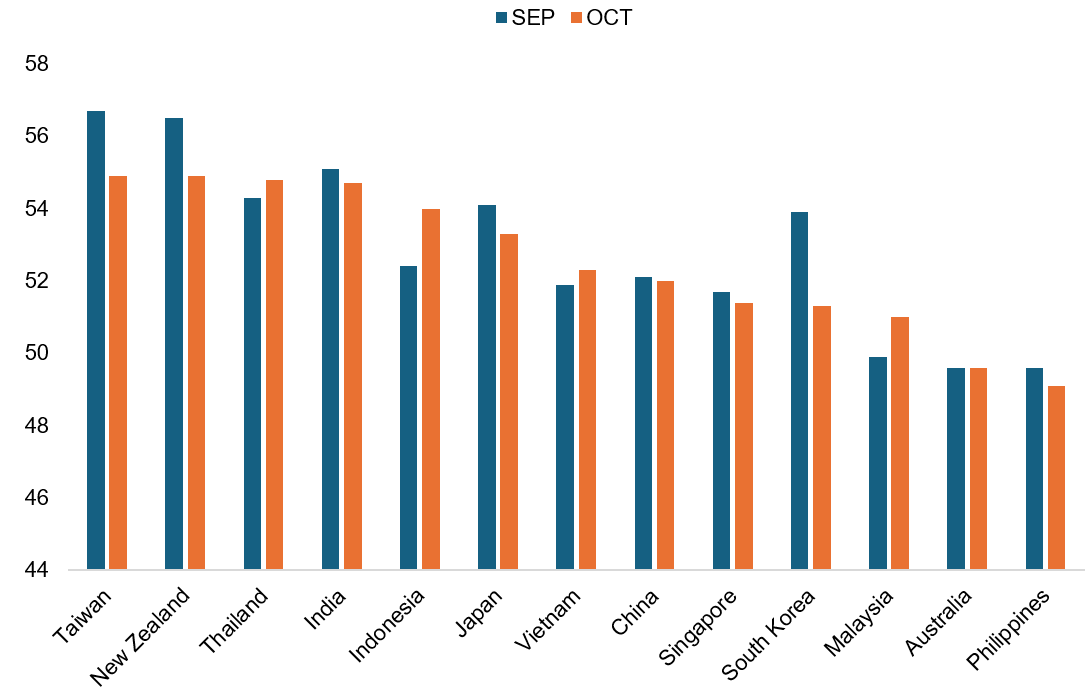
Manufacturing activity across Asia remained broadly expansionary in October, with most economies reporting PMI readings above 50. Australia (49.6) and the Philippines (49.1) were notable exceptions, signaling modest contractions. Overall, the data suggest that regional manufacturing remains relatively resilient despite higher energy costs, geopolitical uncertainty, and uneven domestic demand.
The technology cycle showed early signs of


myTCB® Members get exclusive access to webcasts, publications, data and analysis, plus discounts to events.